Palazzo Ducale - Doge's Palace
Sights & ActivitiesThe Origins. The First Doges
The first stable settlements in the lagoon probably came just after the fall of the Western Roman Empire (476). Gradually, these became more established, and may actually be considered as outposts of the Byzantine empire. It was probably with the approval of the Byzantine emperor that, in the seventh century, the figure of a Dux - in Venetian, Doge - was instituted to oversee the autonomous administration of local affairs; by the time of the election of Teodato Ipato in the middle of the eighth century, the role of the Doge in public life was firmly established. Throughout its more than one thousand years' history this position would remain a publicly-elected office and never take on the attributes of monarchy.
At the beginning of the ninth century, the city of Venice was taking shape, and - largely due to its distance from Byzantium - enjoying a good measure of independence. This autonomy was even underlined from a religious point of view when the city changed its patron saint: from the oriental figure of St. Theodore to the evangelist St. Mark (whose mortal remains, later historians would write, were actually conserved in the city).
In 810 the Doge Angelo Partecipazio moved the seat of government from the island of Malamocco to the area of Rivoalto (the present-day Rialto). It was at this period that it was decided to built a palatium duci, a ducal palace. The model chosen for this structure may have been the Palace of Diocletian at Spalato; however, no trace remains of that ninth-century building.
The Doge's Palace
The Old Castle (10th-11th cent.)
Though we do not know with certainty what that old palace looked like, it is probable that it was an agglomeration of different buildings destined to serve various purposes, the whole thing being protected by a canal, stout walls and massive corner towers.Traces of those fortifications and corner towers have survived.
Reached by a large fortified gateway that was more or less where the Porta della Carta now stands, the buildings within these walls will have housed public offices, courtrooms, prisons, the Doge's apartments, stables, armouries and other necessary facilities.
The outline of crenellated walls that appears in the earliest extant Map of Venice - that drawn up by Fra Paolino - may be taken as giving us a summary account of what the palace looked like.
The Palace of Doge Ziani (1172-1178)
In the tenth century the palace was partially destroyed by a fire, and the subsequent reconstruction work was undertaken at the behest of Doge Sebastiano Ziani (1172-1178).
A great reformer, this doge would radically change the layout of the entire area of St. Mark's Square. For his palace, he had two new structures built: one giving onto the Piazzetta (to house courts and legal institutions) and the other overlooking St. Mark's Basin (to house government institutions).
Thus the old castle which had been closed in upon itself was opened outwards, to meet the needs of a city that was developing and expanding in political, social and economic terms.
What did these new palace structures look like? Probably, they had all the characteristic features of Byzantine-Venetian architecture, of which the Fontego dei Turchi is a typical example.
Only a few traces of this period of building works remain: parts of a ground-level wall base in Istrian stone and some herring-bone pattern brick paving.
The Fourteenth-century Palace
At the end of the thirteenth century it became necessary to extend the palace once more. Political changes in 1297 - the so-called "Closure of the Great Council" - led to a considerable increase in the number of people who had the right to participate in the meetings of that legislative assembly (the "closure" had, in fact, led to the number of the Great Council's members increasing from four hundred to one thousand two hundred). Hence, the need for a radical re-thinking of the palace, in the new language of Gothic architecture.
The work which would result in the building that is familiar to us today started around 1340 under Doge Bartolomeo Gradenigo (1339-1343) and was concerned principally with the so-called palazzo del governo - that is, the side of the palace overlooking the lagoon. Documentary evidence enables us to identify some of the craftsmen involved in this stage of the work: for example, in 1361, a certain Filippo Calendario was appointed as stonemason/sculptor and a Pietro Basejo as magister prothus foreman. In 1365 the Paduan artist Guariento was commissioned to decorate the east wall of the Great Council Chamber with a large fresco; whilst the windows in the room are the work of the Delle Masegne family.
The Great Council would met in this new chamber for the first time in 1419.
The Renovations of Doge Francesco Foscari and the Fifteenth Century.
Only in 1424, when Francesco Foscari was Doge (1423-1457), was it decided to continue the renovation work into the side of the building overlooking the Piazzetta, which housed the courtrooms.
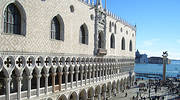
The new wing was designed as a continuation of that overlooking the lagoon: a ground-floor arcade on the outside, with open first-floor loggias running along the facade and the internal courtyard side of the wing. At the same level as the Great Council Chamber was another vast room, known first as the Library and then as the Sala dello Scrutinio. The large windows and the pinnacled parapet took up the same decorative motifs as had been used on the waterfront facade.
This Piazzetta façade was then completed with the construction of the Porta della Carta (1438-1442), the work of Giovanni and Bartolomeo Bon.
Work on the other wings of the palace would not come until later. These would start with the construction of the Foscari entrance beyond the Porta della Carta, culminating in the Foscari Arch. This work dragged on for some years and would not be completed until the time of Doge Giovanni Mocenigo (1478-1485).
The Other Wings of the Palace and the Various Fires in the Building (1483-1574)
In 1483 a violent fire broke out in the side of the palace overlooking the canal, which housed the Doge's Apartments. Once again, important reconstruction work became necessary and was commissioned from Antonio Rizzo, who would introduce the new architectural language of the Renaissance into the building. An entirely new structure was raised alongside the canal, stretching from the Ponte della Canonica to the Ponte della Paglia. Work - on the Doge's Apartments, at least - was completed by 1510. In the meantime Rizzo had been replaced by Maestro Pietro Lombardo, who would oversee the sculptural decoration of that facade and of the Giants' Staircase in the internal courtyard of the palace. In 1515 Antonio Abbondi, known as Lo Scarpagnino, took over from Pietro Lombardi, with work finally being completed in 1559. At that point, the palace was complete, with each organ of public administration and government housed within its own specific premises. In effect, one can say that the 1565 erection of Sansovino's two large marble statues of Mars and Neptune at the top of the Giant's Staircase marked the end of this important phase of work.
However, in 1574 another fire destroyed some of the rooms on the second floor of this wing, causing particular damage to the Room of the Four Doors, the Collegio Antechamber, the Collegio itself and the Senate Chamber - fortunately, without undermining the structure as whole. Work began immediately on the replacement of the wood furnishings and, above all, the interior decor of these rooms.
The 1577 Fire
Work on this refurbishment had hardly finished when another huge fire damaged the Sala dello Scrutinio and the Great Council Chamber, destroying works by such artists as Gentile da Fabriano, Pisanello, Alvise Vivarini, Carpaccio, Bellini, Pordenone and Titian. As far as the structure itself was concerned, reconstruction work was rapidly undertaken to restore it to its original appearance, and was already completed by 1579-80 (when Niccolò da Ponte was Doge).
The Prisons and other Seventeenth-century Work
Up to this point the Doge's Palace had housed not only the doge's apartments, the seat of government and the city's courtrooms, but also a jail (on the ground floor, to the left and right of the Porta del Frumento). It was only in the second half of the sixteenth century that Antonio da Ponte ordered the construction of the New Prisons, built by Antonio Contin around 1600 and linked to the palace itself by the Bridge of Signs.
This transfer of the prisons left the old space on the ground floor of the Palace free, and at the beginning of the seventeenth century work began on restructuring the courtyard. In the wing that houses the courtrooms, a colonnade was created that was similar to that on the Renaissance facade opposite, whilst on the inner side (opposite the waterfront wing of the palace) a marble façade was constructed alongside the Foscari Arch. Designed by Bartolomeo Manopola, this is decorated with blind arches and surmounted by a clock (1615).
The Palace after the Fall of the Venetian Republic
For more than a thousand years, the Doge's Palace had been the heart and symbol of political life and public administration within the Venetian Republic. Hence when that Republic fell in 1797, its role inevitably changed.
Venice was subjected first to French rule, then to Austrian, and ultimately (in 1866) became part of a united Italy. Over this period the Palace was occupied by various administrative offices as well as housing the Biblioteca Marciana (from 1811 to 1904) and other important cultural institutions within the city.
By the end of the nineteenth century the structure was showing clear signs of decay, and the Italian government set aside sizeable funds for extensive restoration. It was then that many of the original capitals of the fourteenth-century arcade were removed and substituted; the restored originals now forming the core of the collection in the Museo dell'Opera. What is more, all the public offices occupying the building were moved elsewhere, with the exception of the State Office for the Protection of Historical Monuments, which is still housed in the building under its modern title of the Superintendence for the Environmental and Architectural Heritage of Venice and its Lagoon.
In 1923 the Italian State, the owner of the building, appointed the Venice City Council to manage it as a museum open to the public.
Since 1996 the Doge's Palace has been part of the network of museums that comes under the management of the Venice Museum Authority.