

The magic of Castello
The artistic treasures in Venice's largest district
Bordering San Marco, Castello is the largest district in Venice, home to the city's Arsenal , Naval history Museum and any number of beautiful churches.
Dead Doges and Naval History
A walk along the Riva degli Schiavoni allows the visitor to admire one of the very first Venetian houses of worship to be built in gothic style: the Church of San Zaccaria. Further on, in Campo di S.Maria Formosa, there is the church of the same name designed by Mauro Coducci in 1492, which jealously guards the tombs of some 25 Doge.
On the other side of the bridge of S.Biagio, two immense anchors mark the entrance to the Naval History Museum, built in 1958 in warehouses where Venice's wheat supplies were once stored.
The Naval Museum houses a fascinating collection of exhibits dating from the times of the Marine Republic to the present day: from the gold covered boat used by the Doge during the procession held on Ascension day, to the gondola once belonging to Peggy Guggenheim, the famous American art collector
Naval History Museum: Skip The Line
Ideal for those who want to explore the history of Venice's relationship with the sea.
Get your tickets now!
Fish and ships
In the same area we find the Campo Bandiera e Moro, with the Church of S. Giovanni, where Vivaldi was baptized, and the Church of San Giorgio dei Greci, this latter famous for its leaning tower.
The Riva degli Schiavoni, lined with colorful stalls laden with the work of local craftsmen and women, was where both Petrarca and Henry James once resided.
Wandering through the modest residential area of Castello we come to Via Garibaldi which, with its proliferation of new fish restaurants, bars and shops, has come to be considered the most vibrant part of the Castello district.
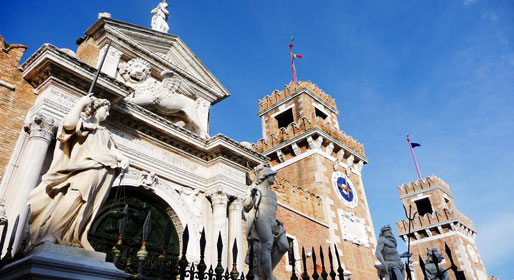
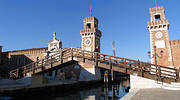
The Arsenale, with its two watch towers straddled by a giant winged lion, was founded in 1104 and was one of the most important shipyards in the whole of Europe. The work force numbered a staggering 16.000 men who, in war times, were capable of churning out two ships a day
Great churches
Once over the wooden bridge of Quintavalle, we come to what is arguably the district's most important monument: the Basilica of S.Pietro. Once the cathedral of Venice, this magnificent house of worship with 54 meter high dome was built in the 17th century based on the designs of Palladio.
Not far from here, we find the 16th century Palazzo Patriarcale and bell tower, the only one of its kind in the city, built in Istria stone by Mauro Coducci. Beyond Campo S.Giuseppe and the Church of the same name, we access Venice's flower-filled Biennale Gardens.
Castle art
The Biennale art exhibition was first held in 1895. Today the exhibits to be seen at the Biennale are divided in to six categories: music, cinema, visual arts, architecture, theatre, and dance, and displayed in the 29 pavilions of the Gardens of Castello and in the enormous spaces of the Arsenale.
The most anxiously awaited event held in the city is, without doubt, the Venice Film Festival: held each year towards the end of August and attended by a host of glamorous international movie stars.
Itineraries
Hotels in the area
- Useful links
- Venice
- Venice Hotels
- Arsenale Hotels
- Venice (all hotels)