

A jewel called Urbino
A journey back in time to the Italian Renaissance and "a city in the form of a palace".
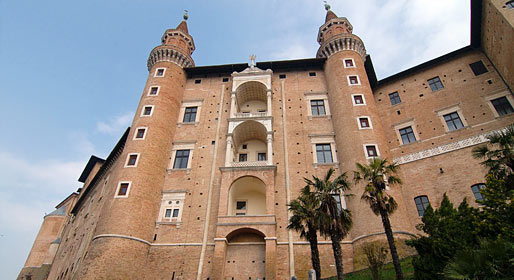
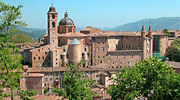
Modern day Urbino still appears much as it did in the 16th century, after the Dukes of Montefeltro, the then rulers of much of central Italy, had completed the realization of what was to be their own personal version of the ideal city.
Raphael's home town
This tour of Urbino commences along the panoramic pathway which winds its way through the narrow lanes of the oldest part of the city to Piazzale Roma and the statue erected in honor of Urbino's most famous citizen, Raffaello Sanzio (alias Raphael).
It then skirts around the massif defense walls of the Albornoz Fortress, which was built in the 14th century by the Cardinal Egidio Alvarez de Albornoz and offers sweeping views over the rooftops of Urbino and the lush and incredibly fertile valleys of Montefeltro.
Urbino makes much of its connection with Raphael, who was one of the principal artists of the High Renaissance and a street in the city has been dedicated to him
The house which is reputed to be the artist's birthplace is now the seat of the Accademia di Raffaello; here numerous drawings, paintings, sculptures, ceramics and woodwork associated with the artist are displayed.
Valdier's cathedral
Urbino's Duomo was built on the site of the city's early 17th century cathedral, which was completely destroyed by the earthquake which shook the city in 1784. Giuseppe Valdier was the architect responsible for this new Neo Classical style edifice, a work which represented a bold move away from the predominantly Renaissance cityscape into which it was introduced.
Adorning the walls of the cathedral, a series of paintings, dating from the 15th to 16th century, which, miraculously, survived the earthquake, give an idea of the ancient splendor of the original building which Valdier's house of worship replaced.
The Duke's palace
From the cathedral, our tour of Urbino proceeds in the direction of the city's most famous landmark: Palazzo Ducale.
This beautifully conserved 15th century edifice, once the Renaissance court of Duke Federico of Montefeltro, was used as the setting for Baldassare Castiglione's "Book of the Courtier", the definitive account of Renaissance court life
The Duke of Urbino did not want a castle with which to defend his realm but rather a sumptuous palace in which to receive his subjects, hence the highly decorative nature of the building, complete with souring turrets, grand entrance staircase, magnificent throne room and arcaded courtyard, all of which were designed by the Vrana-born architect, Luciano Laurana.
The evolution of renaissance art
Whilst travelers in centuries past would have seen all of the historic buildings covered in this tour, they would have missed the opportunity to view the world-famous collection of artworks in the National Art Gallery of the Marche. This collection is now housed in the halls of the Palazzo Ducale.
The museum route takes today's visitors on a fascinating journey exploring the evolution of Renaissance art in central Italy, courtesy of works by artists of the caliber of Paolo Uccello, Piero della Francesca and, of course, Urbino's much revered home-grown talent: Raphael.
Itineraries
Main destinations
Hotels in the area

- Useful links
- Marche
- Urbino Hotels
- Marche (all hotels)