
Delicious devotion
Land of saints, poets and gastronomic delicacies
A journey visiting some of Umbria's most sacred places, might easily be combined with a taste or two of the region's superb gastronomic products.
Sausage, truffle and spelt
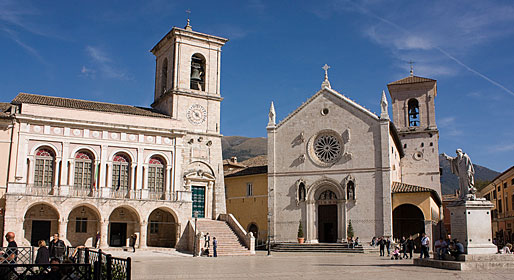
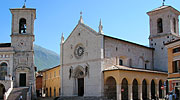
Our itinerary commences in Norcia, for the gourmand, the realm of the spicy "norcineria umbra" sausage, truffles, and spelt, for the devout, the birth town of Saint Benedict, the monk who founded the order which bears his name and the legendary motto "ora et labora" (pray and work).
Norcia's splendid gothic church has been dedicated to the saint.
Lentils and saffron
On the trail of Umbria's famous lentils, we make the trip to Castelluccio, an interesting Medieval town, and the gateway to the National Park of the Sibillini Mountains.
The spring, when the lentil fields and grasslands are in full bloom, is the ideal time to visit the Piani di Castelluccio
We make our next stop at Cascia. The town, where a rare type of saffron is grown, is perhaps best known as the home of Santa Rita and the sanctuary built here in her honor.
An important pilgrim destination the Sanctuary of Santa Rita da Cascia is a modern building consecrated in 1947, and features a mixture of architectural styles and a splendid altar designed by Giacomo Manzù.
The best of Two Worlds - in Spoleto
Our journey proceeds towards Spoleto, host town of the Festival dei Due Mondi, an artistic and cultural event of international fame.
Despite its predominantly medieval appearance, Spoleto's Roman origins can be seen in the Roman theater, the Roman Bridge and the Basilica of San Salvatore
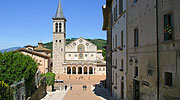
The historic center of Spoleto is home to numerous Romanesque churches. The Cathedral is the town's most important religious edifice, and adorned with the most exquisite mosaics. The Rocca Albonoziana dominates the town from on high.
Totally Todi
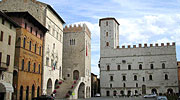
Having arrived in Todi, birth town of the poet Jacopone, we spend time in the splendid Piazza del Poplolo, home to the symbols of the ancient powers which ruled the city: Palazzo dei Priori, the Cathedral, and Palazzo del Popolo, this latter linked to Palazzo del Capitano by way of a massive medieval staircase.
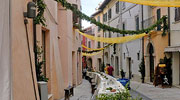
Directly beneath the Piazza, lie the city's ancient Roman cisterns. Beyond the Piazza, within the city's maze of narrow lanes and steep alleyways, all of Todi's medieval character can be seen.
Itineraries
Hotels in the area