
Imperial Capri
Capri in the period of the ancient Roman Empire
This itinerary explores three villas all of which give an insight into the amazing architectural, engineering and artistic achievements of the Ancient Romans: Capri's Villa a Mare, Villa Jovis, and Villa Damecuta.
Although the Ancient Greeks left traces of their time on the island of Capri in the town walls and the Phoenician steps, it was not until 29BC, when Capri was "discovered" by the Romans and the tiny little island gained empire-wide fame.
Like father, like (step)son
Augustus, was the first emperor to fall in love with the island; so much so that he exchanged Ischia for it with the State of Naples. He often stayed here and just before his death in 14AD retired to the island which he called "the island of sweet idleness".
Tiberius, who succeeded Augustus, was equally enchanted with Capri and lived the last ten years of his life here, in self imposed exile
Augustus and Tiberius built not only twelve magnificent villas on the island but also carried out great engineering projects, constructing, cisterns, roads, lighthouses and wharves.
After the death of Tiberius in 37AD, all these were gradually abandoned, neglected, ransacked and left to the ravages of the winds and the weather.
Villa a Mare
Situated on the Northern shore, west of Marina Grande, Villa a Mare (sometimes referred to as "Palazzo a Mare") was built by Augustus and modified by Tiberius.
Villa a Mare was said to be Augustus' favorite seaside residence and covered an area of 850m along the shoreline
A series of terraces dropped down to the sea, supporting a residential quarter, an exedra, loggia, baths, and nymphaeums.
Steps led to a landing place and to different tanks in which fresh water and sea fish were bred. Inland, large cisterns for collecting rainwater supplied the needs of the villa. Only ruins of this grand residence remain: some of Tiberius' baths, small stretches of wall and terracing.
The removal of ancient marble and artworks in the 18th and 19th centuries and the levelling of the area to create a parade ground in the 19th century have obliterated most of this ancient villa complex.
Villa Jovis
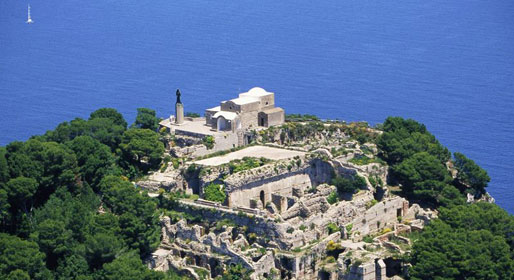
Situated on the western promontory of the island, on Monte Tiberio, Villa Jovis is by far the best preserved of Capri's Imperial villas.
Building of this amazing complex was begun under Augustus and continued by Tiberius. Although only substructures survive, the edifice exemplifies the tremendous architectural and engineering skills of the Romans.
At the centre of the complex was the great cistern around which other sectors were constructed. The cisterns collected rainwater for drinking but also to service the three baths located to the south, the frigidarium, tepidarium and caldidarium, the temperature of which was regulated by furnaces.
On the eastern side were the reception areas and on the northern side, separate from all other rooms, were the imperial quarters, leading to a 92metre long loggia, with panoramic views, all richly ornamented with marble, mosaics and statues.
The leap of Tiberius
Tiberius was happiest away from Rome and in AD26 departed to spend much of the end of his reign on Capri.
In these last years he brooded over the death of his son Drusus and became increasingly psychotic. Haunted by the specter of death, he often consulted his astrologer, Thrasyllus and built for him an observatory the massive foundations of which are sited to the West of the main block.
At the edge of the cliff to the south there is a precipice known as "Salto di Tiberio' from where the emperor apparently forced unsatisfactory servants and unwelcome guests to leap to their death
Find out more about Villa Jovis, Capri
Villa Damecuta
Occupying an equally panoramic and strategic position the Villa Damecuta is on the opposite side of the island, in Anacapri.
The ruins of the villa are sited in an archaeological park on a western point above Punta dell'Arcera and the Grotta Azzurra.
Very little remains of what is thought to have been an even larger villa complex than that of Jovis.
Judging by the finds that have been uncovered and the existence of the finest Greek marble columns, it is probable that the villa was richly adorned.
It may have extended down the hillside to Gradola, its wharf, and have included the Grotta Azurra Nymphaeum.
The site plan seems to follow that of the typical Roman Seaside villa, with rooms opening off a long colonnade overlooking the sea. This loggia was 80metres long with a panoramic portico.
The troubled Tiberius may well have spent the hottest days of the year in Villa Damecuta, cooled by the breeze, and contemplating the magnicent view of the Bay of Naples, far from the worries of Rome
Find out more about Villa Damecuta, Anacapri
Itineraries
Hotels in the area