

Divine revelations
From the Aniene river, the main influence on Tivoli's history, to the mountains of Sabina.
The beauty of the Italian capital extends far beyond the walls of the city and makes its presence felt throughout the province of Rome. No more so than in Tivoli, the history of which has always been linked to water: the water of the river Aniene which traverses the town and the thermal spring waters which surface in nearby Bagni di Tivoli.
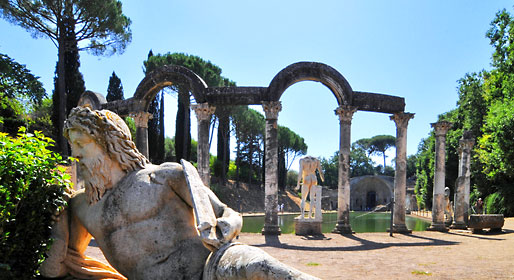
Emperor Hadrian was the first ruler to fall helplessly in love with the town of Tivoli, and it was here, in the twenty years between 118 and 138 A.D, that the Emperor built his magnificent Villa Adriana
Villa Adriana
No ordinary palace, Villa Adriana was conceived as a town within a town, in which Hadrian chose to represent all the most important of the empire's eastern territories.
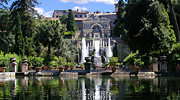
Many centuries later, in the 1500's, Cardinal Ippolito d'Este built another impressive villa in Tivoli. Work on the Villa d'Este was entrusted to Pirro Ligorio, who designed the property's Italian garden and the fountains which are fed by water from the river Aniene.
The river passes by another of the town's important edifices: the Villa Gregoriana: an elegant 19th century villa which has a stunning view of the Aniene waterfalls.
Umbilicus Italiae
From Tivoli, our journey proceeds towards the borders of Lazio, between Umbria, Marche and Abruzzo. Once inhabited by the ancient Sabine population, from which the area derives its name, Lazio's "Sabina" centers around the city of Rieti.
Inhabited by the Ancient Romans, who constructed the bridge traversing the river Velino, modern day Rieti conserves much of its medieval aspect. The Palazzo Comunale, which houses Rieti's Civic Museum, dates back to the 13th century, but was extensively reconstructed in the 18th century. The Cathedral of the Assunta was built even earlier, in the 12th century, and sports a fabulous Romanesque bell tower.
In Sabina, visitors will find both excellent sporting facilities and age-old houses of worship and, in fact, Rieti lies at the foot of Monte Terminillo: Lazio's most important ski resort
In the steps of St Francis
Those eager to follow the trail left by St Francis d'Assisi need travel just a few kilometers to reach the Forte Colombo Convent, also known as the Sinai Francescano. This is the place where Francis was subjected to the cauterization of his diseased eyes and had a vision of Christ.
Visited on more than one occasion by the Saint of Assisi, the convent Church of San Giacomo Maggiore in Poggio Bustone conserves an interesting cycle of frescoes recounting the life of the "poverello."
Those wishing to experience the incredible peace and tranquility of the hermitage, another of the saint's spiritual refuges, will need to make the considerable climb up to the Sacro Speco Santuary, positioned some 1000 meters above sea level.
Park and pasta
This journey through Lazio concludes with a visit to the Gran Sasso and Laga Mountains National Park. Here, visitors can take one of the many pathways and trekking routes through the park, or spend time exploring the medieval town of Amatrice.
The Church of San Francesco, with its elegant Gothic portal, is one of the town's most important landmarks. Amatrice's Civic Museum contains a collection of artworks originally displayed in churches in the town and the surrounding area.
Of course no visit to Amatrice can be considered complete without having first tasted the town's Pasta all'Amatriciana: arguably Lazio's most-loved pasta dish
Itineraries
Hotels in the area


- Useful links
- Lazio
- Amatrice Hotels
- Rieti Hotels
- Tivoli Hotels
- Lazio (all hotels)