
When dreams are made of stone
Scarzuola and the ideal city of Tomaso Buzzi.
In Umbria, even in the most profane of places, it's easy to feel a sense of the sacred. No more so than in Scarzuola.
To reach Scarzuola, from the A1 motorway exit at Fabro and follow signs to Montegabbione and then Montegiove. Circa 1.5 kms beyond Montegiove, a road sign indicates the dirt track leading to the Scarzuola Monastery.
Legend, history and the arrival of Buzzi
Legend has it that in 1218 St Francis passed through this part of Umbria on his return journey to Perugia, and was so struck by the beauty of the landscape, that he single handedly, built a tiny, rudimentary, hermitage here.
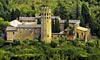
Some years later, Nerio di Bulgaruccio erected a church on the same spot. In the early 15th century, the modest house of worship was enlarged and transformed in full-blown Franciscan monastery.
In 1876, the monks abandoned the site and the monastery gradually fell in to ruin until 1956, when it was purchased by Tommaso Buzzi, one of 20th century Italy's most interesting and irreverent architects who, over a period of some twenty years, realized his awesome autobiography in stone here.
The sacred city of Buzziana
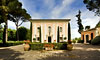
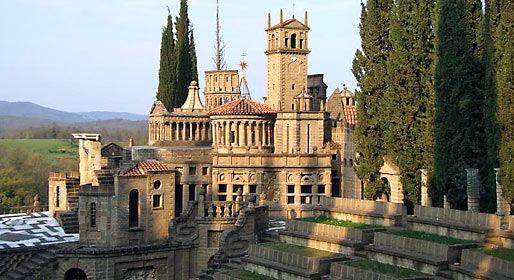
The first part of the project involved the restoration of the convent's original structure. Buzzi called this the Sacred City. He then transformed the monks' vegetable garden and pergola into an elaborate, Renaissance style garden, complete with ornately sculpted box trees, statues, and fountains, which, with the figure of a nymph, evoke Polifemo's myth of love.
From here, the pathway towards the ideal city known as Buzziana commences, and it is here that the real fun begins.
An allegorical labyrinth, a flamboyant, neo-mannerist inspired folly complete with towers, spires and gateways, a gigantic termitarium: describing Buzzi's ''architectural delirium'' is no easy feat
Subverting reality
Inspired by the Franciscan origins of the site, Buzzi used architectural, literary, and alchemical metaphors to subvert reality and give life to a series of magnificent edifices, built in the local tuff stone, and to a city conceived as theatrical machine symbolizing man's road to purification.
Three doors mark the entrance to Buzziana, each opening onto a different symbolic pathway through the city, a city comprised of a vast conglomerate of buildings, stairways and pools, with a total of 7 theaters which parallel Shakespeare's 7 ages of man.
Conceived as Frozen Music, Buzziana is laden with symbols, codes and quotations, inhabited by monstrous creatures, all designed to amplify the visitor's sense of disorientation
The Stairs of Giobbe have been built in the form of the body of a whale, creating a shadowy passage, at the end of which the light appears incredibly bright and the cypress tree at the center of the Temple of Apollo has been struck by lightning, thus creating a natural astrolabe.
The story continues....
Following Buzzi's death in 1980, work on the ideal city was continued by the architect's nephew, Marco Solari, who today personally accompanies visitors through the fantastical world which his uncle created.
La Scarzuola
Montegabbione - Terni
To book a visit:
Ph: +39 0763 837463
Art
Hotels in the area