
Tuff times
Sacred paths, burial grounds, and ancient cities carved out of rock.
Tuff (from the Italian tufo) is a soft reddish colored rock especially common in Italy and, in particular, in the area of central Italy where the regions of Lazio, Umbria and Tuscany meet.
Consisting of consolidated volcanic ash ejected from vents during a volcanic eruption, tuff is relatively easy to cut and its presence in the land which later became known as Etruria favored human settlement here from the Iron age right up to the arrival of the Etruscans, who built both major cities and complex necropolises here.
Etruscan Maremma
Sorano, Sovana and Pitigliano feature high on the list of the architectural jewels of "Tuff Maremma".
Sovana's "Città del Tufo" archeaological park, explores the changing relationship between the natural landscape and man over time
The necropolises were built on the tuff ridges which follow the course of the area's rivers. Today they are often surrounded by dense vegetation, which suddenly opens up to reveal monumental tombs such as the Ildebranda and Sirena
Sacred paths
Heading into the Mediterranean scrub, visitors discover a series of sunken pathways cut in to the tuff rock.
It is thought that these via cave or tagliate passageways, which can reach a depth of up to 20 meters and a width of circa 3 meters, were excavated by the Etruscans as part of a complex defense strategy.
The sunken paths are considered sacred because they created a line of communication between the burial grounds and other places of worship.
Teaching tombs
A visit to the Alberto Manzi Open Air Museum in Pitigliano is, perhaps, one of the best ways to learn about the fascinating history of the Etruscans.
The museum is divided into two sections: the "city of the living" and the "city of the dead", linked by the "via cava" of Gradone.
In each "city", visitors can observe both typical dwellings and an "explanatory" tomb, illustrating the life led by the past inhabitants and their poignant journey into the afterlife.
The dying city
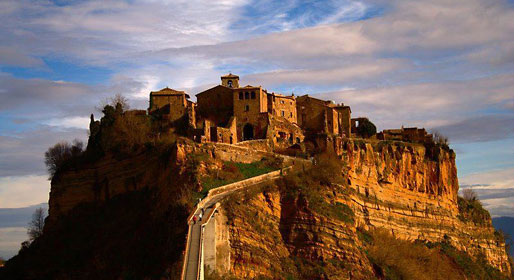
A victim of the unstoppable forces of erosion and destined, sooner or later, to crumble into the valley lying beneath it, the town of Cività di Bagnoregio, between the Tiber river and Lake Bolsena, is often referred to as the dying city.
Now home to just fifty houses, a cathedral, and an eerie silence which lingers in the abandoned streets, Cività di Bagnoregio was once a lively and prosperous town.
Today's population is made up of just ten fearless stalwarts, occasionally augmented by the arrival of those intellectuals and artists who have elected Cività di Bagnoregio as their preferred spiritual retreat
The town dominates the Calanchi Valley where the area's rivers, the rain, and the wind have all feasted on the tuff cliffs, creating a lunar landscape of deep ravines, sudden chasms and vertiginous precipices.
The dark path
Norchia, again of Etruscan origin, is situated in the province of Viterbo, in the part of Etruria traversed by the old Via Clodia road and boasts the largest burial ground in the whole of Tuscia.
Built on the high rocks surrounding the town, the necropolis dates back to the IV and II centuries B.C. Decorative friezes and columns still adorn many of the tombs.
The Cava Buia (dark path) owes its name to the darkness created by the vegetation, at times so thick that it stops the light from penetrating into the passageway. On its sheer walls, inscriptions from the ancient Roman and medieval times can still be seen.
Although entrance to these sites is free, due to the impervious nature of the terrain and the thick vegetation, to fully experience the beauty of this mysterious land, it is a wise choice to have the assistance of a guide
Art


Hotels in the area