
Great Italian walks
A trip to Southern Italy to experience two of the country's most spectacular walking itineraries.
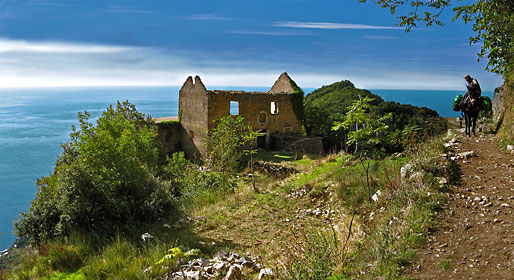
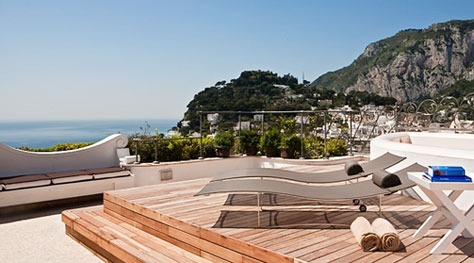
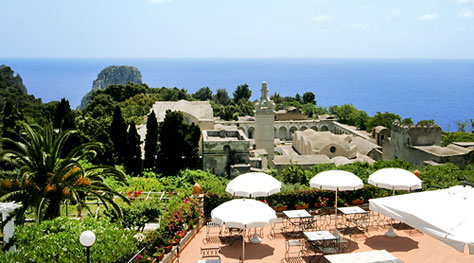
On the island of '''Capri''' and the '''Amalfi Coast''', walking along tracks which existed long before the invention of the combustion engine. Panoramic footpaths, through some of the most beautiful landscapes in the whole of Italy.
Sentiero degli dei, Amalfi Coast
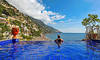
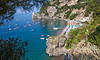
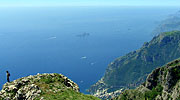
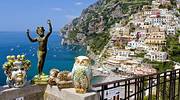
The deep blue of the sky above, the intense azure of the sea below, the lush green of the surrounding vegetation, and the blocks of white, pink and yellow of the little towns clinging to the rocks: a magnificent display of color which accompanies visitors walking along the Sentiero degli Dei, the Amalfi Coast's most stunning coastal pathway'''.
The walk unites Bomerano, fraction of Agerola, with Nocelle, passing by sweet scented lemon groves and terraced vineyards, through countryside where the air is laced with the pungent Mediterranean aromas of rosemary, myrtle and the sea, surrounded by a silence broken only by the sounds of nature
The footpath commences in Bomerano, in Piazza Capasso from where signs indicate the 7km long route. The pathway is initially protected, if not completely enveloped, by the mountain.
Beyond the fork in the road, and in the direction of Nocelle, the panorama suddenly opens up to reveal a spectacular vision of cliffs crashing in to the sea, Punta Campanella, the islets of Li Galli and the island of Capri.
At this stage, the walk becomes more strenuous, and the risk of suffering an attack of vertigo considerably higher. During the descent towards Nocelle, glimpses of the picturesque town of Positano continue to appear and disappear, as if by magic.
At the end of this three hour walk it is hard to know whether you're short of breath due to the effort required to complete the route or as a response to the staggeringly beautiful scenery experienced.
From May to October the pleasure of the walk is increased further by the opportunity to attend series of classical and contemporary music concerts, held in some of the most attractive places along the route, such as Li Cannati and Colle Serra
Scala Fenicia, Island of Capri
Until 1877, the only way of getting from the port of Capri to the town of Anacapri was provided by the Scala Fenicia: a flight of some 900 steps carved in to the rock face by the industrious ancient Greeks.
This incredible work of civil engineering was given the name of Phoenician Steps by 18th century Neapolitan scholars who were convinced of a Phoenician presence in the Mediterranean prior to the arrival of the Greeks and tended to attribute to this population all those constructions which they reputed as having been built antecedent the Greek dominion.
The steps commence in the area of Marina Grande close to the Palazzo a Mare and the Church of San Costanzo, this latter housing the relics of the patron saint of Capri.
Step after step, the Scala Fenicia winds its way through the houses, and above the fragrant patches of woodland.
Along the route, a series of majolica plaques indicate the seven crosses carved in to the rock so as to protect the traveler from misfortune and injury
The Scala Fenicia covers a height of some 200meters, becoming more and more panoramic, as walkers gradually climb up the steps.
A little more than two thirds of the way up, the little Chapel of S Antonio, patron saint of Anacapri, provides a welcome resting place.
The steps come to an end close to the rock of Capodimonte, near to '''Villa San Michele''' and the old Porta della Differenza which once marked the boundary between the towns of Capri and Anacapri.
The considerable effort required to climb the steps is generously compensated by the immense beauty of the surrounding scenery, any leg strain paling in to insignificance if one thinks of how, centuries ago, the women of Anacapri used to descend the 900 steps so as to collect fresh water from the Truglio spring and climb back up again, balancing the large jugs filled with water on their heads.
Nature
Hotels in the area