
Bay watch
Ischia, Procida, Capri: the pearls of the Bay of Naples
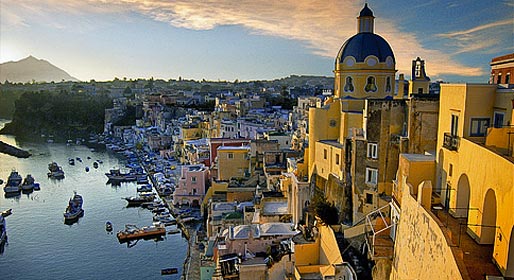
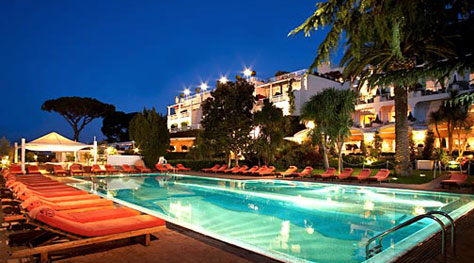
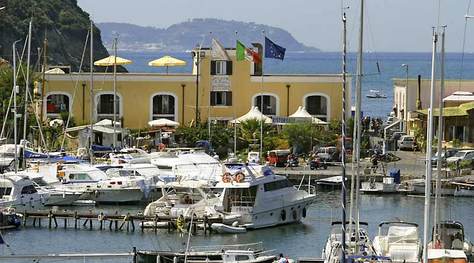
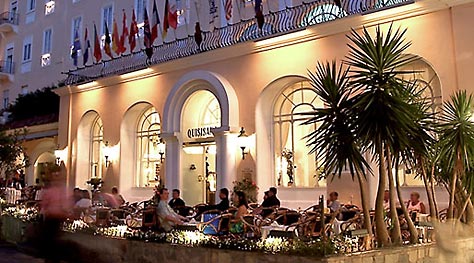
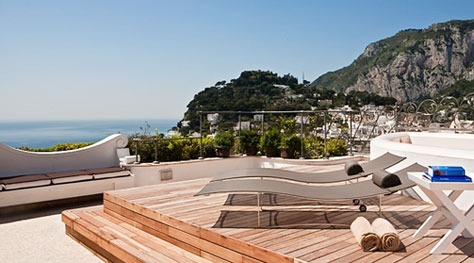
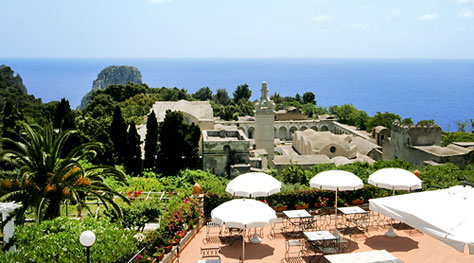
The blue waters of the Bay of Naples are home to the Phlegrean islands of Procida and Ischia and the legendary little island of Capri.
Irresistible Ischia
Ischia and Procida, with its satellite islet Vivara, are all of volcanic origin. Ischia is the youngest of the islands in volcanic terms, the most recent eruption having occurred in 1302. Since Roman times, visitors have been coming here to experience the curative benefits of the volcanic mud and many hot thermal springs welling up from the thermal water basin beneath the island's surface.
Known as the "Green Island" because of its abundant flora - citrus trees, pines and vineyards, the island has fine hotels, gorgeous beaches, sophisticated restaurants and a beautiful mountain - Mount Epomeo (788m).
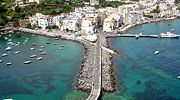
Ischia Porto and Ischia Ponte together form the largest town on the island. In 474B.C. a castle was built on rock lying just off Ischia Ponte. Over the years this was further fortified and in 1441 Alfonso V of Aragon connected the castle to the mainland by way of a stone bridge.
Today you can reach Ischia's Aragon Castle through a tunnel or by a modern lift and explore the terraces and many buildings constructed within the complex
Beach and spa
Travelling northwest along the coast you reach the Marina of Casamicciola Terme, renowned for its thermal springs since 1607 when a free thermal spa was set up for the poor. A few kilometers west is Lacco Ameno - favorite haunt of the rich and famous.
Citara beach is famous for its sunshine and the spring water which gushes into the beautiful sea. The Romans consecrated this site to Venus Citara - a white marble statue of whom has been found here. The Poseidon Thermal Park on this beach has, amongst other amenities, 22 sea and thermal swimming pools and a Roman sauna.
The village of Sant'Angelo is on the south side of the island. Just a short distance away are the Spiaggia della Fumerole with its boiling sands (30-100 degrees) and, at Cavascura, the oldest thermal baths on the island.
Picture perfect Procida
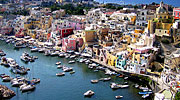
The smallest and the oldest volcanic island in the Bay of Naples, Procida has been described as an "undiscovered garden" with its flourishing orange and lemon groves. The small fishing ports with their colorful houses - white, yellow, ochre and pink- cling to the cliffs. There are no big hotels here. The many watch towers on the jagged coastline bear witness to a turbulent past. Seeking safety, the island's population settled in a fortified village behind the Terra Murata, protected by a 16thcentury castle in what is now the historic centre of Procida town.
The ferry brings you to Marina Grande, the port, dominated by the dense battlements of the island's most important building, the Palazzo Montefusco. The center of Marina Grande is the Piazza, watched over by the "Sailor's Church", Santa Maria della Pieta.
Did you know? The award winning films Il Postino and The Talented Mr. Ripley were both filmed on the island of Procida!
To the north are unspoilt beaches - Silurenza and Punta della Lingua. Cinema buffs may prefer the charming Cala del Pozzo Vecchia to the west, nicknamed "Spiaggia del Postino". The magnificent Chiara and Ciraccio beaches are particularly popular in summer.
Just off the southwestern tip of Procida is the tiny islet of Vivara, connected to the main island by a bridge. The crescent of cliffs is part of an ancient volcanic crater. This uninhabited isle with its mantle of flora was designated a Nature Reserve in 2002.
Capri calling
For centuries Capri was the playground of Roman Emperors who built villas and undertook great engineering projects on the island. Augustus had a favorite seaside villa here and his successor Tiberius built what is now the best preserved Roman Villa in Italy, Villa Jovis.
In the 17th century, Capri became popular with European artists and musicians, writers and intellectuals. Today it is still a magnet for well-heeled jetsetters''' and aging playboys.
The ferry which brings you to Capri docks in colorful Marina Grande, the main port and departure point for trips around the island.
Take a trip around the island by boat: not just to experience the beauty of the amazing Grotta Azzurra, but to see the other caves and coves which surround this lovely island too.
On shore, from Marina Grande you can take the Funicular to Capri's famous Piazzetta. From here you can explore the little alleyways, take a stroll along Via Vittorio Emanuele and Via Camerelle past designer shops and galleries to the famous promenade, Via Tragara.
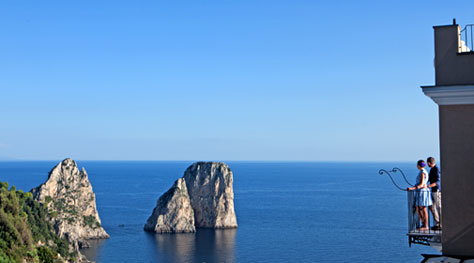
Walking eastwards along Via Tragara there are beautiful vistas of the Faraglioni, 3 sea stacks set in the emerald sea. If you have enough time and energy, continue along the Pizzolungo coastal path with its stunning seascape, to see Curzio Malaparte's avant-garde villa on the tip of Punta Massullo, the Grotta di Matermania and the Natural Arch'''.
Back in the centre of the town, south of Via Vittorio Emanuele, is the beautiful medieval Charterhouse of St Giacomo. A short distance from the charterhouse are the lovely public gardens and Frederick Augustus Krupp's Via Krupp which zig-zags its way down to the to Bay of Marina Piccola.
Escape to Anacapri
Leave the bustle of Capri town and take a bus or taxi around hairpin bends to the quieter Anacapri, high on the hill to the west.
Until the 1870s, Anacapri was only accessible by over 500 steep steps, known as the Phoenician steps.
The steps reach Anacapri near the Villa San Michele, built by the Swedish physician, Axel Munthe. From the gardens which surround this remarkable villa and the pathway outside it there are splendid panoramic views over Marina Grande and beyond.
In the alleyways of Anacapri you will come across the Church of St Sophia, flanked by colorfully tiled seats and the Church of St Michael Archangel with its precious majolica floor depicting the Expulsion from Eden.
From Anacapri there are stunning walks along the cliff tops or you can take the little chair lift to the highest point on the island - Monte Solaro
From here you can see the whole of Capri, the neighboring islands of Ischia, Procida and Vivara and, on a particularly clear day, even the mountains of Calabria!
Itineraries
Hotels in the area