

Shopping and art in Milan
Architectural masterpieces and spellbinding window displays, all within a few square meters.
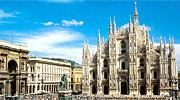
The hub of the old city of Milan is the cathedral, the third biggest in the world, which dominates and dwarfs everything around it.
The exterior, described by D.H. Lawrence as "an elaborate wedding cake", is a mix of pink, grey, peach and fawn marble topped by 135 spires.
From the top of the highest (108.5metres) a gilded bronze figure of the Virgin looks down upon the city.
Duomo di Milano, Rooftop & Museum
Explore Italy's grandest Gothic cathedral and enjoy stunning views.
Get your tickets now!
Beautiful inside and out
Behind the elaborate facades the interior is no less monumental. The floors are covered in white marble ornamented with red and black. The carving and decoration is heavy. The stained glass is splendid. And there are a multitude of interesting works of art, the most notable of which are the Gian Giacomo Medici tomb by Leone Leoni and D'Agrate's grotesque representation of St. Bartholomew.
Next to the cathedral, Milan's Palazzo Reale has been transformed into an art gallery containing works from the medieval period to the 20th century
The gallery and the opera house
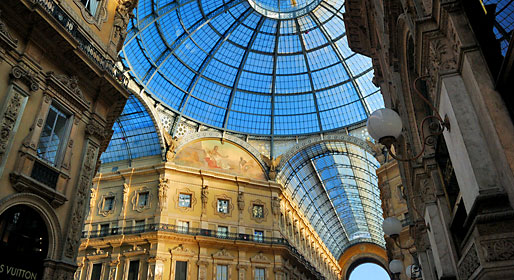
As if in antithesis to the dominance of the cathedral, Italy's commercial prosperity is celebrated in the nearby ''"Galleria"'. Elaborate decorations look down upon this marble paved concourse, beneath massive iron and glass vaulted roofs.
The Galleria Vittorio Emanuele II was designed by Guiseppe Mengoni between 1865 and 1877. With its upmarket shops, cafes and restaurants this is one of Milan's most fashionable places to be seen.
The Galleria leads the way to exclusivity of a different sort, represented by the world's most famous opera house - La Scala. Composers such as Rossini, Bellini and Verdi made their debuts here.
You may not be able to enjoy an opera, but you can see the sumptuous interior with a ticket from the Scala Museum.
La Scala Theater & Museum
Put your ruffled collars on for changing opera and theater-related exhibitions.
Get your tickets now!
Great houses of worship
South West of the cathedral, the Basilica of St Ambrogio is one of the oldest churches in Milan and one of the most important medieval buildings in the whole of Lombardy'''. St Ambrose consecrated the church in 386 and, in 397, was laid to rest here alongside the martyred St. Gervase and St. Pratsus.
The church and convent of Santa Maria delle Grazie were completed in 1469 and represent a fascinating combination of Italian Gothic and Renaissance architecture.
the church and convent of Santa Maria delle Grazie is custodian of one of the most famous works of art in the world - Leonardo da Vinci's "Last Supper"
Second World War bombing destroyed much of the building, but Leonardo's "Last Supper" was saved.
The painting, which is included in UNESCO's World Heritage list, hangs on the end wall of the convent's refectory. Opposite the Leonardo is Giovanni Donato Montefano's "Crucifixion".
The Last Supper
The ultimate Da Vinci experience - available on Wednesdays and Saturdays.
Get your tickets now!
Castle art
To the North of Santa Maria delle Grazie you can see the Castello Sforzesco - rising overpoweringly above the Parco Sempione - its squat round towers, aggressive brickwork, drawbridge and arrow slits reminding us of a turbulent past.
Today, inside this mighty fortification, there are beautifully laid out museums and an important art collection which includes the Pieta by Michaelangelo and Leonardo da Vinci frescos.
Milan by night
Milan's most famous art collection is that housed in Palazzo di Brera.
Amongst all the treasures hung here, paintings by Mantegna and Piero della Francesca are, perhaps, the greatest crowd-pullers.
It is in the district of the Brera and neighboring Navigli that "the other" Milan "comes out to play" at night.
Pinacoteca di Brera: Fast Track
See Hayez's iconic 'The Kiss' and countless more Italian masterpieces.
Get your tickets now!
Shopping
Hotels in the area
- Useful links
- Lombardy
- Milan Hotels
- Monza Hotels
- Lombardy (all hotels)