
Grand Tour of Friuli
Grado, Aquileia, Palmanova, and Villa Manin: great masterpieces of the past
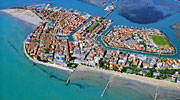
The name Grado comes from the Latin "gradus", meaning port. The Romans built this town to serve as seaport for the nearby city of Aquilea and equipped it with an impressive military station to defend it.
It is said that the inhabitants of Aquilea sought refuge in the "castrum" of Grado when Attila and his Huns attacked. The invasion by the barbarians signaled the end of the patriarchate of Aquilea, status which was transferred to Grado.
Grado's great houses of worship
For more than eight centuries, the Basilica of Sant'Eufemia (579 A.D) functioned as the powerful expression of the town's religious importance and, to this very day, the church and its magnificent mosaics is one of the town's major attractions.
The pavement of the Basilica offers a marvelous display of Byzantine style geometric designs, spread over 700sqm of mosaic
Nearby, there is the Lapidary Museum in which numerous ancient statues and epigraphs are housed, and an octagonal baptistery, also paved in mosaic.
Just like Venice
Among the narrow waterways and little squares which make Grado feel almost Venice-like, any number of artistic treasures can be found. The Basilica of Santa Maria delle Grazie is just one of these.
This unique Church, is built on two levels and is, in fact, the product of two different designs. Building work was initiated by the Bishop Cromazio in the 4th century but it was not until some 200 years later that the then Bishop Elia supervised its completion.
Of the Basilica della Corte, only the mosaic pavement remains, now protected beneath a glass covering. A system of raised walkways allows visitors to admire the artwork
Aquilea's Palaeo-Christian treasures
From Grado our next destination is, quite inevitably, Aquilea. Here the patriarchate was established following the Edict of Constantinople and the Basilica dei Patriarchi testifies to the town's immense historical and religious importance.
This beautiful edifice was built on the site of a previously existing 9th century Basilica which had itself been constructed on Palaeo Christian foundations.
The church's Palaeo-Christian origins can be seen in the 760sqm mosaic pavement - the largest in the whole of the Christian West
For those wishing to better understand the religious history of Aquileia, a visit to the town's Museum of the Patriarch is an absolute must. Another museum of certain interest is the Palaeo Christian Museum, in which mosaics recovered from the ruins of a number of churches can be observed.
Palmanova and Passariano
In Palmanova, time seems to have stood still for centuries. With its star shaped town plan, stretching out in to 9 points, Palmanova might easily represent the ideal Renaissance city. At the center of the town, there is a hexagonal shaped piazza dominated by the cathedral.
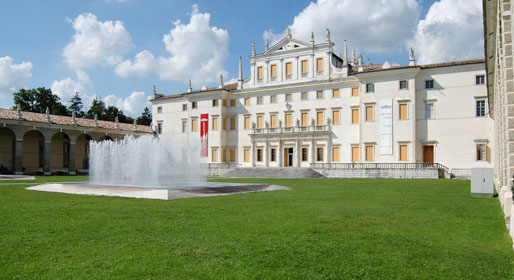
From here, we travel just a few kilometers in the direction of Passariano to find a true masterpiece of the Italian renaissance. Villa Manin was named after Ludovico Manin, the last doge of Venice, who habitually spent his vacations here.
It was in Villa Manin that Napoleon Bonaparte signed the 1797 Treaty of Campoformio, which led to the Republic of Venice being assigned to the Austrian Empire
Today, this splendid residence houses a Contemporary Art Center and the Carriage Museum.
Itineraries
Main destinations
Hotels in the area