
I Fortini coastal walk
The recently restored footpath grants access to some of the most beautiful scenery in the whole of Anacapri.
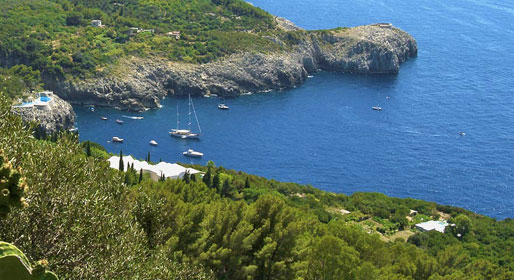
Capri's "Sentiero dei Fortini", is a stunning walking route along the coast of Anacapri, from Punta Carena and the lighthouse to the island's Grotta Azzurra, past a series of old blockhouses or "fortini".
Whilst the proficient walker may well be able to complete the walk in under two hours, those wishing to go at a leisurely pace and include various stops to relax and admire the spectacular scenery can expect to take up to three and a half hours.
Don't forget to use a sunscreen, wear comfortable shoes, and take a supply of drinking water with you!
Fortino di Pino and Fortino di Tombosiello
Walking along the via Nuova del Faro, visitors reach the westernmost part of Anacapri, known as "Limmo" from the latin limen or boundary.
Almost at the end of this road, the descent to the Fortino di Pino block house commences, next to which, on the left, there is the Fortino di Tombosiello, situated beneath the imposing lighthouse.
The low Mediterranean scrub thrives thanks to the warm climate and the sea water which covers it during high tides; so much so that the rich vegetation bursts out of each and every crevasse in the limestone rocks
At the start of the 19th century, the French attempted to conquer Capri, which at the time was under the rule of the Bourbons and the British. On the 4th of October 1808, some 2000 men under the command of General Lamarque and Captain Colletta, surprised the cannonless British, by suddenly landing at Orrico and Gradola.
Fortino di Mesola
After Cala di Mezzo, the route continues across the stone periplus and down a flight of steps carved in to the cliff face which links the Passo della Capra with the Fortino di Mesola.
Like all of the stone blockhouses, that of Mesola merges perfectly against the limestone rock and it is easy to imagine how they once protected the high plain of Anacapri to the sound of cannon fire.
Fortino d'Orrico
In the 19th century, what had been watch towers built during a period in which this part of the Italian coast was particularly prone to attack by the Saracens, were transformed in blockhouses by the British and French for short range artillery fire.
The last of the blockhouses on the route, the Fortino d'Orrico, is positioned above the promontory of the Grotta Azzurra. Here, the vegetation becomes thicker, contrasting with the crystal clear waters lapping the bay of Cala del Rio below. It is from here that the magnificent swimming pool of Villa Rovelli can be seen.
Want to know more about the island of Capri? www.capri.net
Itineraries
Main destinations
Hotels in the area