Umbria suggested itineraries

Cittą di Castello, Assisi and the delightful Gubbio

An enchanting place of immense natural beauty and important works of art.

Cittą di Castello, Assisi and the delightful Gubbio, Umbria

The journey starts in Umbria's most Northern town, Città di Castello, where modern and historic Italy combine. Begin your visit in Piazza Garibaldi at the Palazzo Vitelle a Sant'Egidio, built in 1540. On the same Piazza, in the 15th century Palazzo Albizzini, is an exhibition of work by the local artist, Alberto Burri (1914-95). More work by this famous modern artist can be seen in the Seccatori del Tabacco, which was once used to dry Tobacco. In the Duomo Museum there is work of a different nature, in a collection of sacred art. Masterpieces by Raphael, Luca Signorelli and other great artists are on display in the Pinocoteca Comunale, housed in Palazzo Vitelli Connoniera.

More work by Luca Signorelli can be seen a few kilometres away in Morra, West of Città di Castello. Here, in the Oratorio di San Crescentino is a famous cycle by this pupil of Piero della Francesca. Journey East from Città di Castello to Pietralunga and the Monte Cucco Park, on the border with the Marche. This limestone massif has not only wonderful mountain scenery, including the spectacular Monte Cucco but also the cave system that is the deepest in Italy.

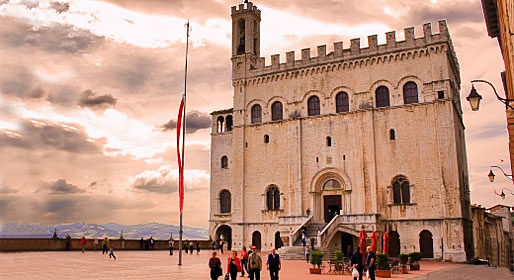
Gubbio has been described as one of the most beautiful medieval towns in Italy. Founded by the Umbrians and an important centre in the Roman era, the town was of strategic and artistic importance in medieval times. Amongst the many buildings to be visited here are the majestic Palazzo dei Consoli, the Palazzo Pretorio and the Palazzo del Capitolo dei Canonici. In a part of the town that has many good bars and restaurants, opposite the Duomo, you will find a history museum in the Palazzo Ducale. The Eugubian Tablets, dating from 200BC and written in the Umbrian language can be seen in the Palazzo dei Priori.

Travelling East from Gubbio you reach the hill top town of Gualdo Tadino, on the site of the Roman Tadinum, a stopping place on the Via Flaminia. The town is renowned for its ceramics and there is an interesting exhibition of this craft in the Museo Civico, housed in the imposing fortress, the Rocca Flea. Further South is Nocera Umbra. Much of the centre of this ancient town was damaged in the 1997 earthquake but there are breathtaking views over the Umbrian landscape. Nearby Bagni di Nocera was famous, from the 16th century until the late 19th century for the healing qualities of their waters.

The next stop, Foligno was not only devastated by the earthquake but was also badly bombed in World War 11. The residue of the medieval monuments are in the Piazza della Republica. The Duomo, with its two facades is the most impressive of the surviving buildings. The Palazzo Comunale, the Palazzo del Podestà and the Palazzo Trinci, (in which there is an art museum) also remain. In the chapel of the Romanesque Church of Santa Maria Infraposta there is a Byzantine mural, which is of artistic importance.

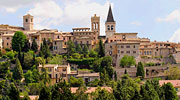
Close to Foligno is the pink stone, hill town of Spello, on the slopes of Monte Subasio. Reminders of the Roman past are everywhere - the Augustan gateways remain in the walls, which surround the town. The centre of the town is medieval. There are many, many churches - there were once one hundred. The most important of these is the 13th century Santa Maria Maggiore, which was frescoed by Pinturicchio in the 16th century. Don't miss the mosaic floor in the Baglioni Chapel. Next to the church is the Palazzo dei Canonici which houses the art gallery. From the Belvedere at the top of the town you overlook a spectacular panorama with a view of the Roman amphitheatre.

Your journey ends in Assisi. They say you need at least four days here! As the birthplace of St. Francis it attracts millions of tourists. Much was destroyed in the 1997 earthquake, but much has been restored. The highlight of a visit has to be the Basilica di San Franscesco, St. Francis' burial place. There are important medieval works of art to see, by Giotto, Cimabue and Simone Martini to name but a few. The city has many more treasures, connected to its history, from its beginnings as a Roman Municipium and also connected to Santa Chiara - St. Francis' first woman disciple and founder of the Poor Clares. A modern dimension was added when world peace meetings were held here under the aegis of Pope John Paul II and Assisi came to mark the finishing post of the peace march beginning in Perugia.


Art, nature, and jazz

Perugia, a city in which ancient history and the contemporary world meet in an intriguing synthesis of art, culture, and tradition....

Gourmet heaven

Umbria, land of medieval cities and ancient culinary traditions, offers an irresistible mix of history and gastronomy. Good food and...

The Renaissance in Umbria

A region of Italy which boasts more than its fair share of masterpieces, Umbria owes much of its staggering artistic heritage to the...


Umbria most popular destinations.

Assisi

Assisi is known throughout the world as the city of St Francis, the monk who spoke to the animals and with God, whose cult has...

Bevagna

The heart of Bevagna is linked to the Roman era, as can be seen by its position along the Via Flaminia as well as various Imperial...

Cittą di Castello

Each and every visitor arriving at Città di Castello will undoubtedly remain impressed by the medieval walls, built to protect...

Foligno

When one thinks of Umbria, one imagines a region rich in medieval towns perched on the hilltops and mountain side. Foligno...

Gualdo Tadino

Known for its artistic ceramics, Gualdo Tadino is a picturesque medieval town situated on the hillside of Sant Angelo: panoramic...

Gubbio

Welcome to Gubbio, considered to be the pearl of the Umbrian region. Here you will find monuments, the envy of much of Italy and the...

Nocera Umbra

For centuries famous for its mineral water, from the spur of rock on which it was built Nocera Umbra dominates the valley of the...

Pietralunga

Grouped around its imposing Lombard Castle, Pietralunga sits on the top of a hill overlooking the Carpinella Valley - a strategic...

Spello

Spello is not only blessed with a superb geographical position, but is also the home of the greatest number of monuments dating back...