
Dominating Sicily
Splendid churches, sumptuous palazzi, crowded streets and a maze of tiny roads and ancient alleyways.

Palermo, Sicily's vibrant capital, is a colorful concoction of grandiose churches, elegant palazzi, and more humble townhouses, all crowded into the streets and narrow alleyways which form the heart of the city.
Hop-on Hop-off Bus Palermo
Explore the Sicilian capital hassle-free with this hop-on hop-off bus tour.
Get your tickets now!
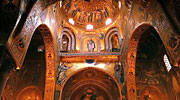
Traces of Palermo's Norman era can be seen in the Palazzo dei Normanni with its Palatine chapel, in the former Church of San Giovanni degli Eremiti, and in the city's imposing Cathedral.
On the outskirts of Palermo
The town of Monreale, just outside Palermo, offers more examples of Arabian-Norman architecture .
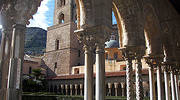
Built in 1174, Monreale cathedral houses mosaics depicting episodes from both the Old and New Testaments. The cloister, featuring some two hundred columns, is a major tourist attractions.
Complex of the Abbey of Monreale
High on UNESCO's World Heritage List, this pretty cathedral in Palermo is the most beautiful Norman church in Sicily. Explore the main place of Catholic worship in Palermo.
Get your tickets now!
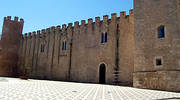
Alcamo, with its 14th century Castle of the Counts of Modica and the 15th century Torre de Bellis, is situated on the road leading towards Trapani.
The town is known for the excellent wines produced here and for being the birthplace of Ciullo d'Alcamo, considered to be the first Sicilian poet to have composed verses in the Italian language.
Temples and statues made of bread
Having left Alcamo, after just a few kilometers, we come to Catalafimi. Here at the beginning of May each year one of the most keenly-felt popular festivals in the whole of Sicily is held.
During Catalafimi's Festival of the Holy Crucifix, enormous sculptures made from bread are marched through the town as a sign of respect for the work of the farm laborers
Just outside Catalafimi, at the foot of Mount Barbaro, the Temple of Segesta, is a perfectly conserved Doric temple.
Climb a little higher up the mountain to see the Greek theatre, the stone tiers of which were carved directly out of the rock face.
Island watching
Shortly before we arrive in Trapani, from the heights of Mount San Giuliano, the perimeter wall of the town of Erice appears.
This fascinating little town, with its narrow streets lined with attractive stone houses and courtyards, is pervaded by an atmosphere of centuries past. This is where the ancient sanctuary of Aphrodite once stood.
From Erice magnificent views as far as the Egadi islands can be admired.
Coral and marble
The city of Trapani, once known as Drepanum, lies on a promontory gradually sloping down to the sea.
Trapani's Pepoli museum houses a great number of important artworks including a painting by Titian depicting St Francis and a superb collection of jewelry made from coral
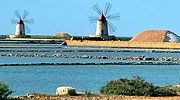
Travelling onwards, along the western coast of Sicily, we come to the Gulf of Stagnone, an area known for its salt marshes and from where boats depart for the islet of San Pantaleo, where traces of the Phoenician city of Mozia have been found, including a large marble statue of a young man, dating back to the 5th century B.C.
Sicilian Kasbah
Further South lies Marzallo del Vallo. This was the very last city to fall under the Norman dominion, in 827, and before such time it had been an Arab settlement. The influences of the various civilizations to have inhabited the city over the years have produced an intriguing fusion of culture and customs.
In the historic center, a veritable maze of narrow winding roads, blind alleys, courtyards, arches, and porticoes, there is an authentic Kasbah where to savor delicious couscous and fish dishes
Temple valley
Our journey continues along the coast towards the archaeological area of Selinunte. Here we find splendid Doric temples and the ruins of an ancient acropolis.
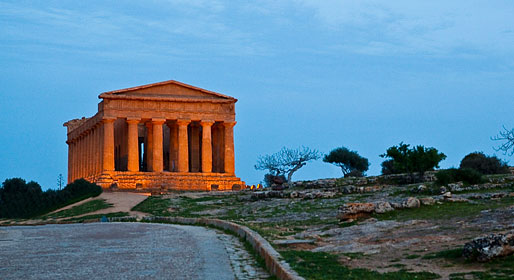
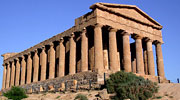
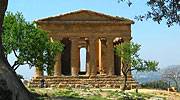
Nearby, lies Eraclea Minoa with its crystal clear sea and long beaches of fine white sand. In no time at all, we reach Agrigento's legendary Valley of Temples, a spectacular archaeological park containing a whole group of sacred monuments, testifying to Sicily's glorious past.
The Valley of the Temples Agrigento: Fast Track
Visit the Valley of the Temples, the largest archaeological location in the world and a UNESCO World Heritage site.
Get your tickets now!
Peak viewing
After the world famous Valley of the Temples, we travel to one of Sicily's lesser known treasures: Caltabellotta.
This tiny town, perched high up on the mountain from where it enjoys a stunning view extending from Mazara del Vallo as far as Mount Etna, is wrapped in a quite unique, almost indescribable atmosphere.
Itineraries
Main destinations
Hotels in the area