ItalyTraveller experience.
Slow trains
Unforgettable journeys through Tuscany and Sardinia, traveling along the regions' panoramic minor railway lines.
Traveling by train along the country's secondary railway lines is an increasingly popular way of experiencing the Italy which lies beyond the major road and rail network. Many of the trains which are used to transport visitors along railway lines which might easily have risked being abandoned had it not been for their new function as tourist routes, are veritable collectors items: locomotives which provide for train buffs and nature lovers alike, an emotion-packed journey, to be enjoyed at the gentle pace of times past. A comprehensive list of Italy's secondary railway lines is contained in Fuori dai soliti binari (Off the Usual Tracks), published by Edizioni Terre di Mezzo, which describes some thirty train journeys through some of the most beautiful, and otherwise inaccessible parts, of the Italian peninsula. The web site www.railtouritalia.com is an excellent online source of information in which to find an up-to-date calendar of train-themed events in Italy.
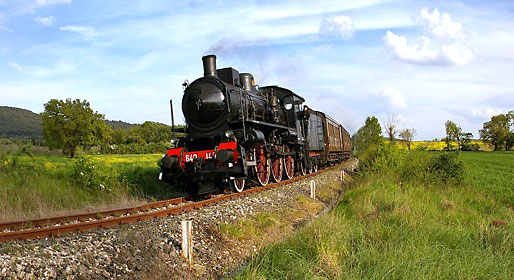
The Trenonatura (nature train) has been created to introduce visitors to the lands of Siena and Val d'Orcia via a series of excursions aboard vintage locomotives. Puffing steam engines lead the one hundred door carriages through Tuscan landscapes which are particularly suited to this form of slow tourism. One of the routes recommended by the Terre di Siena association is the Museum Itinerary, a journey which offers passengers the opportunity of alighting at towns featured on the Musei Senesi circuit. Departing from Siena, the train heads to Asciano Monte Oliveto Maggiore where travelers can visit the archaeological museum of Palazzo Corboli. From Asciano the train journey proceeds to Buonconvento and the Museum of the Mezzadria Senese and the Museum of Sacred Art.
A popular option is that of a Tuscan walking holiday, using the Trenonatura to get from one place to another. Passengers can request to alight at one of the many stops on the Siena-Asciano-Torrenieri-Monte Amiata-Monte Antico route and from these stations, head off along any of the numerous footpaths in the area. Then there are the full day excursions by steam train with departure from Siena, often combined with a special event, such as one of the many gastronomic fairs and wine festivals held in the province.
What better way to explore Sardinia than by climbing aboard the Trenino Verde (www.treninoverde.com)? Promoted by both the WWF and Italia Nostra organizations, the Trenino Verde (Little Green Train) chugs along four breathtakingly panoramic routes, passing through Gallura, Ogliastra, Barbagia and Gennargentu. To reach their final destination (the glorious Sardinian sea), the trains travel through the heart of inland Sardinia, proceeding at what, at times, seems an incredibly slow pace, along single railway lines laid here between the late 1800's and the early 1930's. On the Trenino Verde, holidaymakers can experience exciting journeys, observing the wonderfully unspoilt landscapes and incredible archaeological sites of Sardinia which slowly pass by.
The Nulvi-Palau railway line (the journey actually starts from the stations of Alghero or Sassari), snakes across the Gallura and, after Nulvi, passes next to the Nuragic site of Irru, traveling through a landscape modeled by the area's characteristic hills or "mesas" all the way to Martis, and the area of the Carrucana petrified forest. The train winds its way upwards, through woods of cork oak trees, towards the Gallura mountains and Tempio Pausania, the grey granite buildings of which have led to the town being given the name of City of Stone. At this stage in the journey the route begins to descend towards the coast, past Arzachena, situated at the base of a block of granite sculpted by the wind. Soon after, the sea appears, followed by a breathtaking vision of the Maddalena archipelago, marking the train's imminent arrival at Palau.
The Macomer-Bosa route snakes its way from the coast into central Sardinia, crossing through the vineyards where the Malvasia grapes are grown, to reach the Medieval castle of Malaspina. The Mandas-Arbatax line is the longest tourist railway line in Italy. The 159kms of railtrack starts in the town of Mandas, connected with the city of Cagliari by a regular railway line. After just a few kilometers, the train arrives in the towns of Orroli and Nurri, famous for their archaeological sites containing numerous nuraghi and domus de janas or houses of fairies (the romantic name given to the neolithic tombs). The train starts to make its way up the mountain slopes towards Gennargentu: an exhilarating journey through a series of narrow tunnels and across bridges spanning stomach-churning precipices.
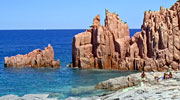
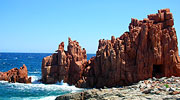
As the train enters the region of Ogliastra the scenery begins to change rapidly, from the fruit orchards of Ussassai to the lunar landscapes of Gairo Tarquisara, before once more meeting the Flumendosa river near Villagrande, offering glimpses of the sea. From here, the route begins to descend amidst the olive groves and vineyards, heading towards the station of Tortoli, a bathing resort famous for its white beaches and stunning red cliffs, before coming to a halt at the station close to the port of Arbatax.
Another train line which commences in Mandras heads deep inland, directly into the heart of Barbagia. After a hilly stretch, the journey proceeds across the valley of Rio Mannu, with a stop at Isili to see the white nuraghe of Is Paras, and then on, into the zone of Sarcidano, as far as Nurallao, across a lush territory of Mediterranean scrub. The train travels across the mountainside, stopping at the station of Laconi, thus allowing passengers to pay a visit to the Aymerich Castle and Museum of Menhir Statues. Entering the Barbagia di Belvi, the railway track skirts the Molza nuraghe and from here the curtain of mountains opens to reveal a magnificent view of the sea of Oristano. After the pretty little station of Belci and Aritzo, the train traverses the valley of Rio Uatzue, passing across impressive viaducts and round serpentine bends before crossing the buttress which leads to the basin of Sorgono, and the station where the journey ends.
Italy Traveller most popular
Alghero
Between two contiguous bays of Rada di Alghero and Baia di Porto Conte, Alghero is situated in a...
Arbatax
On the promontory the summit of which is dominated by the lighthouse of Capo Bellavista, Arbatax...
Arzachena
Situated on a hilltop, Arzachena is dominated to the East by an enormous mushroom shaped granite...
Bagno Vignoni
Bagno Vignoni is a small village in the heart of the Valdorcia, a village where time seems to...
Crete Senesi
Close to Siena one finds a spectacular and truly unique landscape with a marvelous clay soil. The...
Montalcino
A center which could be defined as being immersed in a natural treasure trove made of enchanting...
Oristano
Situated at the heart of the great plane of Campidano, in a central position along the western...
Palau
Palau developed because of its strategic position, on the border between the archipelago of the...
Pienza
Situated on the Via Cassia, just a few kilometers from Cianciano Terme, one finds Pienza. Like...
San Quirico d'Orcia
San Quirico d'Orcia is situated atop a hill within the Valdorcia Nature Park, in an area of...
Sassari
Sassari is the second most populated city of Sardinia. Looking out over the Gulf of Asinara,...
Siena
Siena is reknowned, both nationally and internationally, for the Palio horse race contested by...
Tortolì
Situated between the sea and a great pool, Tortolì is the largest town of the Ogliastra...
Val D'Orcia
Village traditions which have long since disappeared from other areas are perpetuated in this...