
Florence for beginners
The colourful Santa Croce district is an eclectic mixture of artisans shops, medieval and renaissance masterpieces.
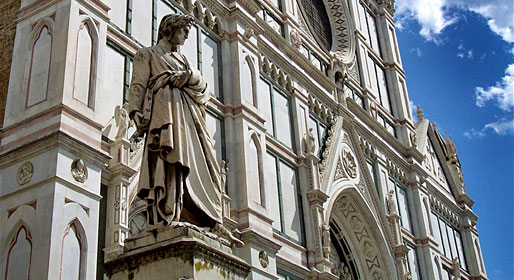
Florence's Basilica of Santa Croce, located in the homonymous piazza, is among the world's largest Franciscan churches and one of the finest examples of Italian Gothic architecture.
The design of the Basilica is attributed to Arnolfo di Cambio, who supervised the building work which initiated in 1294. Although the construction of the edifice was completed some 90 years later, the consecration of the church did not occur until 1444.
In 1865, to commemorate the 600 years since the birth of Dante, a monument was erected in honour of the great poet to the left of the sacristy.
In 1966, the flooding of Florence resulted in serious damage to the basilica and to the many artworks housed within its walls, including a Crucifix by Cimabue, the remains of which are now conserved in the Museum of Santa Croce.
Today, after decades of painstaking restoration work, the Basilica of Santa Croce has returned to all its former splendor
Football crazy
In Piazza Santa Croce, the signs of the center line used to divide the square during the games of football played here since the 16th century are still visible.
Indeed, to this very day, each June, the square transforms in pitch where passionate matches of calcio fiorentino (Florentine football) are played.
Mad about museums?
Heading towards the center of Florence along Via Ghibellina we come to Casa Buonarroti, a 17th century palazzo transformed in museum entirely dedicated to the life and works of Michelangelo, the famous Florentine artist who once owned the property. Continuing past the numerous little shops selling leather goods and hand painted ceramics, we arrive at Florence's late 19th century synagogue and the city's Jewish Museum.
In the nearby Borgo Pinti, lies the Church of Santa Maria Maddalena d'Pazzi, where to admire Pietro Peugino's dramatically poignant fresco of the crucifixion.
Other great works of art are housed in the Bargello Museum, the rooms of which are adorned with masterpieces by Donatello, Michelangelo, Bernini, Verrocchio and Giambologna
The art of government
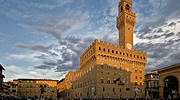
Florence's Piazza della Signoria is home to Palazzo Vecchio, the city's magnificent town hall, in which to find works by Agnolo Bronzino, Michelangelo Bounarrotti and Giorgio Vasari.
The Palazzo was originally known as Palazzo della Signoria, Signoria being the principal administrative body of the Florentine Republic. Over the years its name was changed, first to Palazzo dei Priori and then Palazzo Ducale, before assuming the name of Palazzo Vecchio or Old Palace in 1565, when the court of Duke Cosimo I moved to the 'new' Palazzo Pitti.
The edifice was gradually enlarged to the East so as to quadruple its original dimensions. Vasari, man responsible for many of the artworks within the Palazzo, also designed the corridor linking Palazzo Vecchio with Palazzo Pitti, passing over the river Arno via the Ponte Vecchio.
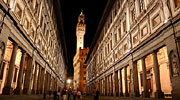
Cosimo I moved his governmental offices to the adjacent Uffizi, now one of the world's most famous art galleries'''
A bridge worth its weight in gold
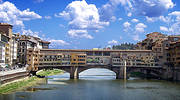
Neri di Fioravante's Ponte Vecchio has become another of the legendary symbol's of Florence. The bridge, constructed in a point where the girth of the river Arno is at its narrowest, is famous for the exclusive jeweller's shops which line either side.
Itineraries
Hotels in the area