

Roman Baroque
Rome according to Bernini and Borromini
Gianlorenzo Bernini and Francesco Borromini. These two men were responsible for great part of the baroque marvels which grace the city of Rome.
Saint Peter's Square and Basilica
One of the most important masterpieces of Baroque Rome is, without doubt, Bernini's colonnade in Saint Peter's Square, designed by the great architect, sculptor and painter, to give the mother church of Christianity an ellipse which would embrace the whole of humanity. The monumental, four column deep colonnade is comprised of a staggering 284 columns.
The interiors of St Peter's Basilica again reveal the hand of Bernini, in the form of the imposing 29 meter high bronze baldichin over the high altar and directly beneath the dome of the basilica, in the point which, according to tradition, St Peter, was buried.
St. Peter's Basilica: Self-Guided Tour + Dedicated Entrance
Priceless artworks in Christianity's most iconic shrine.
Get your tickets now!
Piazza Navona
Gianlorenzo Bernini is the author of another symbol of Rome, the Four Rivers Fountain, in Piazza Navona. On each side of the fountain, there is a statue personifying one of the four major rivers of the four continents recognized by renaissance geographers.
The statues were realized not by Bernini but by his assistants: the Danube by Raggi, the Gange by Poussin, the Rio de la Plata and the Nile by Fancelli
Overlooking the piazza, Borromini's Church of Sant Agnese was built as private chapel for the Pamphili family, owners of the adjacent palazzo. It was Pope Innocenzo X Pamphili who requested the intervention of Borromini, who immediately set about dramatically altering the initial designs for the church made by Carlo Rainaldi.
Sant Ivo alla Sapienza
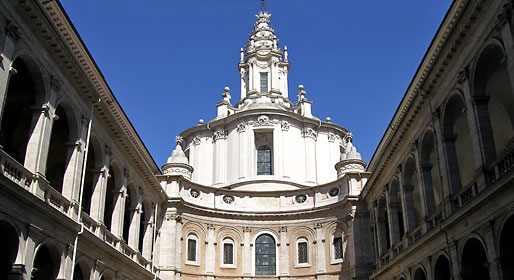
Just a few steps from Piazza Navona we find another of Borromini's masterpieces, the Church of Sant Ivo alla Sapienza, which served as university chapel right up until 1935, year in which the Sapienza, as the University of Rome is known, was transferred to its present day campus.
The dome has an unusual spiral form (inspired, according to legend, by the snails' shells which Borromini collected) and culminates in a crown of flames symbolizing charity, the principal virtue of Saint Ivo, protector of lawyers
Palazzo del Quirinale
So as to admire yet more works of Roman Baroque, we head to the Colle Quirinale, now home to the President of the Republic of Italy.
The Palazzo del Quirinale, open to the public each Sunday morning, testifies yet further to Bernini's artistic genius, manifested in the Loggia delle Benedizioni and the Torrione, a defense tower requested by Pope Urbano VIII so as to protect the palazzo which served as papal residence until 1870, when it became the Royal Palace of the Savoy.
Sant Andrea and San Carlo alle Quattro Fontane
In his Church of Sant Andrea, close to the Quirinale, Bernini used quite extravagant quantities of marble and gold, thus ensuring that, as the sunlight filtered through the windows, an incredible display of shimmering light would be produced.
Bernini's Church of Sant Andrea al Quirinale, is almost unanimously considered the pearl of Italian Baroque
Just a few steps away from the Church of Sant Andrea, we find another impressive work of 17th century architecture, this time by Borromini. The Church of San Carlo alle Quattro Fontane is a veritable explosion of baroque flamboyance: its sumptuous facade, characterized by a succession of concave and convex lines, realized entirely in stucco.
Itineraries
Main destinations
Hotels in the area

- Useful links
- Rome
- Pantheon Hotels
- Rome (all hotels)