The Tuscany of Grosseto, Saturnia, Orbetello, Capalbio and the Argentario
The Maremma, the area of Tuscany which was once the heartland of the Etruscans stretches along the Southern Tuscan coast and inland to the hills of the Alta Maremma and the Tufo Area.
After the Etruscan era, the coastal areas deteriorated into marshland and swamp, infested with malarial mosquito and inhabited only by charcoal burners, shepherds and cowboys, the "butteri". It was not until 1950 that the malarial mosquito was eliminated. As a result, this is one of the last unspoilt stretches of coastline in Italy.
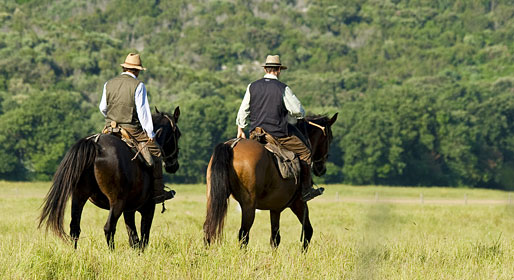
Travelling south from Grosseto you reach the Parco Naturale della Maremma. The Monte dell Uccelli, a long whale backed series of hills, form the backbone of the park. Old Spanish watchtowers dot these beautiful wooded hills, which, as their name suggests, are home to many resident, migrating and nesting birds. The forest-covered hills give way to grasslands, where the "butteri" tend their half-feral horses and white cattle, and to beautiful beaches. There is no public road to the park, which is reached by bus or canoe, on foot, bike or horseback from Alberese.
Just outside the park you come to the ancient fishing village of Talamore, once an Etruscan town. The Sienese planned to make this sheltered harbour into a port that would rival that of Pisa, but clogging weed foiled the attempt.
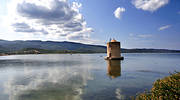
Leaving behind the Ucellini Park, the Via Aurelia Etrusca leads to the mouth of the Albegna River and to the Tombolo di Giannella, a sand spit which joins Monte Argentario, once an island, to the mainland. Another sandspit, or "tombolo", was also built up by the sea currents, to the south thus forming a lagoon, the Laguna di Ortobello, between the "island" and the mainland. The Romans constructed a causeway between the mainland and Ortobello on Argentario which divided the lagoon. The sheltered lagoons, only one metre in depth, draw hundreds of birds here, including rare species, and offer amazing bird watching opportunities.
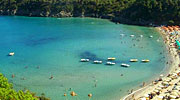
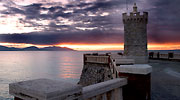
The scenery of the mountainous Monte Argentario, which reaches 635 metres at its highest point, Il Telegrapho, is dramatic, with headlands, bays and shingle beaches. Much of the area is still uninhabited and superb walking country. The main tourist centres are the ancient ports of San Stefano and Ercole. Three 16th century castles, remnants of the Spanish fortification of the Argentario, look down upon the yacht-filled harbour of the attractive little town of Porto Ercole.
Before heading inland to explore the main centres of the ancient people who once occupied this coast, pause to visit the hill-village of Capalbio, with its perfectly intact medieval centre and fortifications by Albrandeschi, one of the war lords who in the middle ages dominated this area. From the 217 metres hill on which the village perches, there are superb views. Below, you can see the fine Capalbio beach enclosing the lagoon - Burano another protected nature reserve, rich in bird life.
Leaving the coast, the road travels deep into the hills of the Marrema to the Area del Tufo, one of the most important Etruscan centres. Tufo is a volcanic porous rock used here for centuries as building material, for stone "bricks" or hollowed out to form tombs, cellars and sunken "via cave", pathways. The towns of Pitigliano, Sorano and Sovana form a triangle enclosing the protected area the "Città del Tufa".
As you approach from Manciano, the cliff-top town of Pitigliano soars above you, its quarters linked by the arches of a medieval aqueduct. Etruscan tombs pock the cliffs. The great fortress dominates the town. The cellars of this mighty fortification now house a museum. Behind the fortress, from the beautiful Piazza della Republica there is a stunning view. Via Zuccarelli brings you to a synagogue and old Ghetto - once known as "Little Jerusalem", Pitigliano had a thriving Jewish community, established in the 16th century by Jews fleeing the Papal States. Although many of the towns Jews survived Nazi occupation most have now emigrated, but their influence, particularly in the cuisine, is still felt here.
Around Pitigliano the rock sculptured passageways, the Via cave, hollowed out by the Etruscans, spread out in every direction. The "Via Cave di San Giuseppe" is one of the easiest to find -more than 10 metres from top to bottom this pathway leads to Sovana.
9 Kilometres northeast of Pitigliano, along a road lined with tombs and caves, you come to the medieval village of Sorano, high on a promontory at the confluence of three rivers, built to defend the valleys by Etruscans and Romans. A series of landslides threatened the existence of the town in the 1920s. Here, below the perfectly restored example of renaissance military engineering, the Fortezza Orsini, steps lead you to the Selciata pathway- a walk around the town walls.
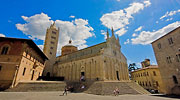
Northwest of Pitigliano is another important Etruscan town, Sovana, dating back to the 7th century BC or earlier. The ancient capital of this part of the Maremma and once a rival to Siena, Sovana is now a little village with ancient ruins and Romanesque architecture. The town was at its most important from 11th century AD, but declined during the 14th Century, - its low lying position made it vulnerable to Malaria - and the Sienese. The intricate 16th century fishbone patterned paving of the Via di Mezzo, the main street, has recently been restored. In the Piazza del Pretorio, at the end of this street is the 13th century church of Santa Maria, one of the most beautiful in Tuscany. You can learn more about the history of the area in the nearby Palazzo Pretorio Museum and in the Torre dell'Architetto find an ancient clock which is operated by a system of weights. From the Piazza you can walk through gardens and olive groves, once thoroughfares, to the huge Duomo and then on to find traces of the Etruscan walls.
North of the town is the Etruscan Necropolis containing over 100 tombs, many of which can be explored- hidden amongst the tufa cliffs and along rivers. The most spectacular tomb, Tomba di Sileno was discovered in 1963. This area forms part of the Tufa Archaeological Park. The unique Città del Tufa, Archaeological Park was opened in 1998. The park covers three areas of interest - Sovana, Vitozza (one of the most important cliff settlements in Italy) and Sorano.
East of Sovana lies the hill town of Saturnia, famous today because of its Spa complex which grew up around the sulphur springs, waterfalls and streams which have drawn those seeking a panacea for their ailments for more than 3000 years. The Etruscans who built the town above are thought to have used these surreal bubbling turquoise waters in sacred rites.
The town itself occupies a strategic position, on the summit of a truncated cone, overlooking the Albegna valley. Known as Aurinia, it was one of the most important Etruscan towns. In Roman times its position on the Via Clodio link added to its significance. The Via Clodio passed through a medieval arc known as the Porta Romana, which rests on Etruscan, or even older town walls. It was the Romans who gave this town its name Saturnia. This ancient town with its many natural beauties typifies this mysterious corner of Tuscany which has been said to be "closer in time and spirit to the ancient Etruria than to the glitter of the Renaissance".