

Naples underground
Hidden wonders of the great Italian city
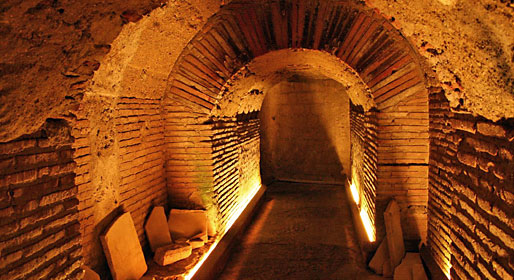

Naples is a city which exists on two levels, one above, and one beneath the surface.
The city lies on partly hydrovolcanic, fine grained tuff, a light rock which is extremely easy to excavate and an important source of building material.
The art of tunnel making
The Greeks were the first to exploit the qualities of tuff in 800 B.C, digging beneath their ancient "Neapolis", in order to construct an aqueduct linked to a series of cisterns via a web of tunnels.
The Romans were responsible for the creation of a veritable "underground city", complete with cemeteries and temples
In the centuries which followed, and as the population of Naples grew, an incredible number of wells and cisterns were built beneath the city. Many of Naples' palazzi were erected above these sites, constructed using the deposits of tuff which had been produced during excavation.
Bomb shelters, theaters and pozzari
The LAES, Libera Associazione Escursionisti Sotterranei organizes visits to underground Naples, which commence beneath the Quartieri Spagnoli, in Vico S.Anna di Palazzo 52
From here, visitors descend some 40 meters to a large 3200sqm cavern, used during the second world war as bomb shelter, and then on to the ancient aqueduct of Carmignano, walking past the cisterns constructed by the Greeks and through a labyrinth of tunnels once connected to more than 4000 wells.
Visitors are led beneath churches and palazzi, to the remains of an ancient Roman theatre, said to have been the favorite playhouse of Nero.
The guides describe how, in the past, every household accessed the water stored in the cisterns by way of domestic wells to which only the "pozzari", or well keepers, had access.
Naples Underground
A guided tour underneath the ancient city of Naples.
Get your tickets now!
The Bourbon tunnel
Another underground thoroughfare, only recently reopened to the general public, the Borbonica Sotterranea was initiated in 1853 by Royal Decree.
The tunnel was designed to link Piazza Plebescito with the area of Chiaia, thus providing a quick escape route for the members of Bourbon dynasty and rapid point of access for troops arriving to protect the royal residences.
The Fabula Vergiliana cultural organization holds a series of readings by the narrators of Mani e Vulcani, performed underground beneath the Complesso Monumentale of San Lorenzo Maggiore
Visitors are conducted by the light of oil lamps, through the bowels of a mysterious and enchanted Naples, listening to the tales of such legendary characters as Virgilio Mago: associated with the myths of the foundation of Naples (as narrated in the Cronaca di Partenope, a 14th century text conserved in the National Library), and thought to be responsible for the surprising absence of snakes and other dangerous reptiles in underground Naples.
Monumental Complex of San Lorenzo Maggiore
Explore this Roman church and the archaeological complex below it at the geographic center of ancient Naples.
Get your tickets now!
Itineraries
Main destinations
Hotels in the area










- Useful links
- Bay of Naples
- Napoli Hotels
- Bay of Naples (all hotels)