

The Castles of Naples
Historic edifices which tell the tale of a city ruled by many of Europe's greatest dynasties.
If stones could talk, those used to construct Naples' castles would speak volumes.
Every ancient building has a fascinating story to tell, even more so when they are castles: historic residences of Royals and Emperors, and more often than not, key players in war and conspiracy.
Perhaps more than those of any other city, the palaces of Naples witnessed the frequent exchange of power, which characterized medieval Europe.
Castel dell'Ovo
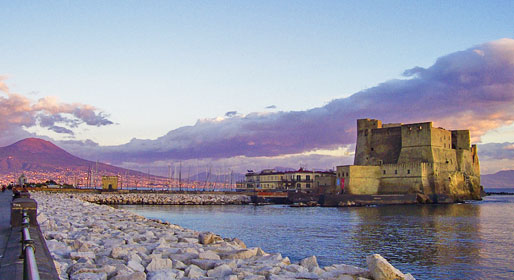
A tour of Naples' castles might easily commence with one of the city's most-loved symbols, the Castel dell'Ovo, or Egg castle.
Legend has it that, hidden away within the castle's underground passageways, there is a cage containing a magic egg, on which the fate and fortune of both the city and the sea-edge castle depends
Castel dell'Ovo sits on the islet of Megaride, which, another legend recounts, was once inhabited by the mermaid Parthenope. It was here, in the 1st century BC that the Roman patrician, Lucius Licinius Lucullus built a magnificent villa, known as the "Castrum Lucullanum".
The first fortifications date back to the times of the Normans. Ruggiero the Norman made Castel dell'Ovo his residence in 1140. When Charles I of Anjou built his new castle in Naples, Castell d'Ovo became the seat of the Royal Chamber and State Treasury.
It was not until the 15th century, during the Aragon domination, that the Castle was given its present form.
Maschio Angioino
The Maschio Angioino is another of Naples best-known symbols, standing right in the heart of Piazza Municipio, from where it guards the Royal Palace on one side and the sea on the other.
Charles I of Anjou decided to construct the edifice to celebrate his coronation as King of Naples and the transferring of the kingdom's capital from Palermo to Naples, in 1266.
The castle as we see it today, with its massive perimeter walls and crenulated towers, is the result of alterations made during the Aragon period.
It was Alfonso V of Aragon who commissioned the castle's magnificent marble triumphal arch, to celebrate his entrance into the city.
The Maschio Angioino is now home to Naples' Civic Museum, the tour of which includes a visit to the Palatine chapel, one of the oldest rooms in the castle
Castel Nuovo (Maschio Angioino): Skip The Line & Guided Tour
An in-depth exploration of Castel Nuovo (Maschio Angioino) on the seafront.
Get your tickets now!
"The Barons" Hall' takes its name from a particular incident in history. It was in this hall, in 1486, that King Ferdinand I of Aragon brought together all of his barons who were guilty of conspiracy, and then had them swiftly arrested.
Castel Sant Elmo
Our tour of Naples' historic strongholds ends with a trip to Castel Sant'Elmo, strategically located on the hill of Vomero, and close to the Charterhouse of San Martino.
Certosa & Museum of San Martino
Stunning inside and out, you'll see an ornate interior created at the height of Baroque architecture.
Get your tickets now!
The panoramic terraces with their sweeping views of the whole of Naples and the Vesuvius, make this imposing building, which is of Norman origin, particularly beautiful.
Castle Capuano
Less well known, but equally important is Castel Capuano. Built in the 12th century, Capuano Castle is named after the city's ancient Porta Capuana, next to which it was constructed.
Over the centuries, the castle has provided the stage for both happy events and heinous crimes: from the sumptuous marriage of Carlo of Durazzo to the murder of Sergianni Caracciolo (the assassination of Caracciolo, a Neapolitan nobleman and prime minister, was organized by his former lover, Queen Joan II of Naples).
Constructed as imposing stronghold, for centuries Castle Capuano maintained its role as unassailable fortress. As time passed, a succession of alterations greatly changed the aspect of both the exterior and interior of the castle and today's building is the result of 18th and 19th century restructuring.
In the 16th century Castel Capuano became the seat of the city's courts, and the castle still stages the opening ceremony of the Judicial year to this very day
Itineraries

Main destinations
Hotels in the area









- Useful links
- Bay of Naples
- Napoli Hotels
- Bay of Naples (all hotels)