

Neapolitan Museums
The history of a city and its museums
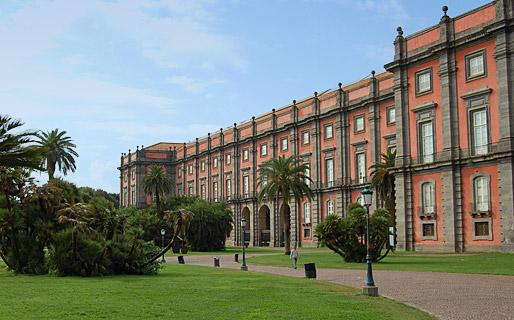

Few cities can boast a historic and artistic heritage as rich as that of Naples.
Founded by the Greeks in the 8th century B.C., for centuries Naples was subjected to numerous invasions and military occupations. Conquered by the Byzantines, dominated by the Normans, ruled by Spain, Austria and the Bourbons, the city nevertheless, enjoyed periods of great economic and cultural development, the traces of which can be found both in the ancient streets of the historic center and in Naples' amazing museums.
National Museum of Capodimonte
Occupying the Palazzo Reale, which was designed for Charles III of Bourbon to house the artworks left to him by his mother, Elisabetta Farnese, Queen consort of Spain, the National Museum of Capodimonte, is Naples' most important museum complex.
Caravaggio's "Flagellation of Christ", Titian's "Danae" and Andrea Mantegna's "Portrait of Francesco Gonzaga" are just some of the works which adorn the National Museum of Capodimonte's walls
Museo e Real Bosco di Capodimonte
Neapolitan art in a sprawling Bourbon Palace in Naples, also one of the largest museums in Italy.
Get your tickets now!
National Archaeological Museum
Just steps away from the central Piazza Dante, in the onetime home of Don Pedro Giron (viceroy of Naples from 1582 to 1586), the National Archaeological Museum houses one of the world's most important collections of Roman and Greek antiquities.
Highlights include the treasures of Pompei, sculptures from Herculaneum's Villa dei Papiri, and the votive niches from Paestum.
National Archaeological Museum of Naples: Entrance + Audio Guide
Explore a late 18th-century museum in an old cavalry barracks and see amazing treasures from Herculaneum and Pompeii in this huge collection.
Get your tickets now!
Charterhouse of San Martino
The Charterhouse of San Martino, is one of the finest examples of Neapolitan baroque architecture. Painstaking restoration work has brought the monastery's exquisite marble paneling, wood carvings, frescos and floor mosaics back to their original splendor.
Located in what were once the living quarters of the prior and the monks' cells, the museum houses numerous paintings and sculptures, including landscapes by Van Wittel, and a superb collection of 19th century Neapolitan paintings.
Certosa & Museum of San Martino
Stunning inside and out, you'll see an ornate interior created at the height of Baroque architecture.
Get your tickets now!
Castel Sant Elmo
Dominating the hill of Vomero, Castel Sant'Elmo, is the city's most prominent landmark. Built in 1329 by Roberto d'Angiò, in 1537 the castle was enlarged to become one of the most modern fortresses of its time, and the pride of Naples' defence system.
The vast Piazza d'Armi complex, complete with officers' lodgings, 16th century church and ramparts overlooking the Bay of Naples is now open to visitors
Villa Pignatelli
On the Riviera di Chiaia, the majestic Villa Pignatelli has been transformed into the Museum of Prince Diego Aragona Pignatelli Cortes.
Constructed in 1826, the Villa was inhabited by a string of aristocratic families including the Acton, Rothschild and Pignatelli. In 1955, the Pignatelli donated the villa, complete with all its furnishings and artworks, to the Italian State.
Itineraries
Main destinations
Hotels in the area









- Useful links
- Bay of Naples
- Napoli Hotels
- Bay of Naples (all hotels)