Art experience.

MACRO and MAXXI

MACRO and MAXXI

Rome looks towards the future with two hi-tech museums dedicated to contemporary art.

In recent years Rome has made major investments, not only in its artistic and archeological heritage, but also in contemporary art forms, as can be seen in the MACRO and MAXXI: two museums destined to become emblems of the avant-garde in the eternal city.

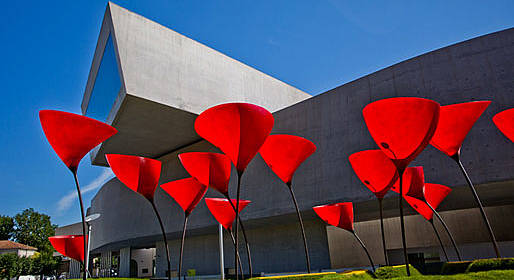
After some fifteen years in the making, the MAXXI (the National museum of 21st century arts), in the district of Flaminio, was finally inaugurated at the end of May 2010. The museum, which houses both MAXXI Architecture and MAXXI Art, was designed by the celebrity architect Zaha Hadid, who was awarded the much coveted Stirling prize for her stunning structure, characterized by sinuous, boa-like forms, and striking cantilevered volumes, illuminated by the light filtering through the steel mesh protecting the glass roof.

MAXXI Architecture houses a series of retrospective exhibitions dedicated to the great protagonists of 20th century architecture and a contemporary section, which gives particular emphasis to the work of young designers and an international vision of 21st century architecture. MAXXI Art boasts a permanent collection of circa 300 paintings, sculptures, installations, and works of video and net-art created by artists of international standing between 1960 and 2000. Clemente, Boetti, Kentridge, Richter and Merz are just a few of the artists featured. The museum aims to be a showcase for experimental art forms and temporary exhibitions.

By the end of 2010 MAXXI Base, the museum's new research center comprised of library, mediatheque, and photographic and contemporary archive will be inaugurated. Less than six months after opening, MAXXI has registered more than 140.000 visitors, but is also functioning as an impressive virtual platform, with thousands of people exchanging ideas and material via the museum's web community.

Like the MAXXI, the new wing of the city's MACRO museum (Museo di Arte Contemporanea di Roma) in Rome's Nomentano district, is the work of a female architect, Odile Decq. Due to open in late November 2010, her glass and black basalt pavilion will add a further 10.000sqm to the former Peroni factory (which was transformed into a museum in 1999), complete with exhibition rooms, a multi-level roof garden for open air exhibitions, a bookshop, and reading rooms. On the ground floor there is a stunning fiery red Auditorium and a room in which Mario Schifano's immense "Chimera", takes pride of place.

The Macro museum is also home to the Macro Testaccio, located in a complex which was once a slaughterhouse, and is one of the most characteristic edifices in this, a part of Rome particular rich in cultural stimuli. The building's 19th century pavilions are an important example of industrial architecture and serve as symbol of the transition between the classic and the modern age.

MAXXI Museo nazionale delle Arti del XXI secolo
Via Guido Reni, 4 A - Roma
www.fondazionemaxxi.it
Opening hours: Tuesday-Wednesday-Friday-Sunday from 11.00 to 19.00 - Thursday and Saturday from 11.00 to 22.00

MACRO Museo di Arte Contemporanea di Roma
Via Reggio Emilia, 54 - Roma
www.macro.roma.museum
Opening hours: Tuesday-Sunday from 9.00 to 19.00


A passion for Paestum

In Cilento, experiencing the magic of Magna Grecia

Red art

The Pepoli museum and the work of Trapani's coral artists

Graves on the rocks

Archeology, history and nature in the necropolis of Pantalica.

The art of love

A romantic escape to Verona - where else?

Lagoon ghetto

Museums, multistory palazzi and synagogues - in Venice

Trentino Revisited

The lakes, castles and modern art between Rovereto and Trento.

Objects of desire (with a double G)

The art of fashion in Florence's Gucci Museum

In Vino Veritas

The history of wine and wineries in Torgiano's Wine Museum.

The image museum

The Alinari National Museum of Photography in Florence.

Selinunte: city of gods

The temples of Selinunte: Europe's largest archeological park.

Revolutionary royal silk

San Leucio: the ancient village transformed in Royal silk factory.

Statues & Steam Engines

Rome's Centrale Montemartini museum.

Melozzo and the Renaissance

Melozzo da Forlì and the 16th century ideal of beauty.

Art in Kalsa

Palermo's Palazzo Abatellis: from Romanesque to Baroque, Sicilian style.

White Passion

Antonio Canova's Plaster Cast Gallery in Possagno.

When dreams are made of stone

Scarzuola and the ideal city of Tomaso Buzzi.

Ligurian witchcraft

The town of Triora and its museum of witches.

Sea-scaping

Genoa and the Mediterranean: from Courbet to Matisse.

Peak viewing

Centuries of art in the Sacred Mountain of Varallo.

Piedmont's castle art

Rivoli Castle's Contemporary Art Museum.

Manta's magnum opus

The secrets of Manta Castle's stunning Late Gothic fresco.

Menhir museum

A trip to Sardinia to discover the mysterious charm of the menhir.

Temple art

Contemporary art in Agrigento's Valley of Temples

Family treasures

The Correale brothers' private art collection on public display in Sorrento.

Diefenbach Museum

The impetuous works of Karl Diefenbach in Capri's Certosa.

The Art of Devotion

A trip to Naples to see the treasure of the city's much-loved saint.

Tuff times

Sacred paths, burial grounds, and ancient cities carved out of rock.

Cardinal Passions

Baroque virtuosities in Rome's Spada Gallery.

Art Factory

The artworks collected by the King of Coats.

Contemporary art in Varese

In Villa Menafoglio, Count Panza's Collection of Art.

Umbria's Renaissance

A journey from Spoleto to Perugia, admiring some of the 16th century's greatest works of art.


Italy Traveller most popular

Rome

Rome, the "Eternal City", is eternally beautiful. In an area measuring just a few...


Featured.

66 Imperial Inn

Guest Houses - Roma.

With its unbeatable location directly opposite the Opera House and its eclectic interior design, 66 Imperial Inn is one of Rome's most fashionable guest houses.

The Inn & the View at the Spanish Steps

Luxury Suites and Penthouses - Roma.

Luxury guest-house located on the famed shopping street, Via dei Condotti, the heart of the historical center of Rome.