
Savoring Salento
A journey through the southern most part of Puglia, experiencing the culture, nature and vibrant social life of a quite magical land.
As you travel into the deep South of Puglia, you'll no doubt be struck by the way the landscape changes, how the hills of Bari's Murgia and the Itria Valley gradually subside so as to make way for a vast expanse of incredibly flat land.
This is how the Salento appears from Brindisi, industrial city some thirty kilometers North of Lecce, where an intricate network of roads from all the principal towns of the Salento converge.
Back to Baroque
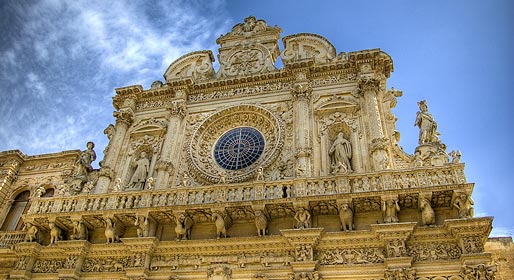
The historic center of Lecce has three entrances, Porta Napoli, also known as the Triumphal Arch, Porta S.Biagio and Porta Rudiae: it is here, in the ancient heart of the city, that Lecce's elegant baroque palazzi and churches can be found.
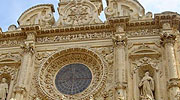
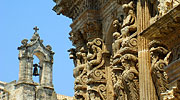
The finest example of Puglian baroque is, without doubt, the Basilica of Santa Croce, a wonderfully ornate edifice situated next to the Palazzo dei Celestini. Exuberant figurative, floral and mythological motifs characterize the façades of both buildings.
Whilst you wander through the historic center of Lecce, pop into one of the city's wine cellars for a glass (or two!) of Puglia's Primitivo di Manduria or Salice Salentino wine
Beaches and bones
From Lecce we travel towards Otranto, via the internal roads running parallel to the coast, past a number of well known bathing resorts such as Torre Specchia and Torre del Orso, resorts named after the ancient watch towers erected to defend the coast from Saracen assault.
The town of Otranto suffered a devastating attack by the Turks in the August of 1480, provoked by its refusal to abandon the Christian faith. The bones of the 700 martyrs of Otranto are still conserved in the town's 11th century cathedral which, miraculously, survived the incursion.
Otranto's Festa dei Martiri is held from the 13th to 15th of August each year
Rags and riches
Proceeding along the coastal road which from Otranto leads all the way to Leuca, past a string of panoramic promontories and enchanting little coves, we arrive at Santa Cesarea Terme, an elegant thermal establishment, renowned for its superb range of spa treatments.
A few kilometers further south, at Castro Marina, we find the karst caves of Romanelli and Zinzulusa, famous for their immense natural beauty and for the prehistoric remains which were discovered inside them.
The Zinzulusa cave is considered to be the most important in the whole of the Salento, and owes its name to the numerous limestone formations which hang from its ceiling like twisted zinzuli ("rags" in Salento dialect)
Pizzi, pucce e pasticiotti
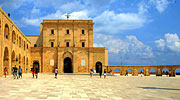
49kms from Otranto, Santa Maria di Leuca is the southernmost town of the Salento.
Here, towering above the point where the waters of the Adriatic and the Ionic sea meet, we find one of Italy's most important lighthouses: a 48m high structure, situated on the cliffs some 102m above the level of the sea. The light transmitted from its lantern can be seen as many as 50kms away.
Food lovers are unlikely to be able to resist the Salento's savory rustico di sfoglia salata or pizzi e pucce, never mind the legendary pasticiotti - deliciously sweet concoctions which take pride of place in all the region's pastry shops.
Itineraries
Hotels in the area